The Disappearance
of Philippa Seilern's
Liechtenstein Foundation
and the Human Suffering it caused
An Investigative Report

Philippa Seilern
1948 - 2018
Table of contents
Home
Ancestry
Preface
Irregularities
History (Post WW II)
Origin and Destination of Philippa’s Foundation
Philippa’s Life
Philippa’s Monte Carlo Will
Breakdown and Management of Philippa’s Foundation
Philippa Seilern apartment, Monte Carlo
Monte Carlo housekeeper first declaration
Second declaration
Relevant facts
Register of payments to Eden Nylen (2019 - )
Philippa's Estate - Questions that demand answers
Afterthoughts
Epilogue
Selected correspondence
Conditions
Miscellaneous
Banque J. Safra Sarasin (Monaco) SA
Portimo Trust reg
Rakuira Ltd.
Gasenza Trust reg - Ayant Droit Economique
Addresses
Liechtenstein Foundations
Industrie u. Finanzkontor Etablissement
Fürstliche Geschäfte
Droht Liechtenstein ein Exodus der Stiftungen?
Case Involving a Liechtenstein Trust
Stealing The Assets of Dead Clients
What is a Foundation (Stiftung)?
Overview of Liechtenstein Foundations
Vermögensverwaltungsgesellschaften
Are Liechtenstein’s trust laws fit for purpose?Ancestry 
Preface
Philippa Seilern was my first cousin (p.5), and I was also her closest living relative. She died of kidney failure on January 17, 2018, two days after being admitted to the hospital in Lagos, Portugal. The following day I received a call from Eden Nylen, the family housekeeper in Monte Carlo, who informed me of her death.
The call itself was surprising; I had not seen Philippa in more than thirty years. But Eden’s explanation was even more unexpected. The following excerpt is from her deposition (p.24):
“Miss Philippa called me from Lagos before her hip operation in April 2017 with the following instructions: if something were to happen to her, I should contact Mr. Peter Seilern Senior (PS Sr.) in Switzerland.
I asked Miss Philippa for his number, and she told me to find it in the family register. When I located it, I asked whether it was correct, since it was in Switzerland, and she confirmed with yes.
I then asked her why she was giving me these instructions. Her reply was, ‘Just in case something happens to me.’
I asked, ‘How about I tell your cousin?’ (meaning Boy who lives in Monte Carlo), and Philippa replied, ‘Do not tell anyone from my Monaco family.’
Her Monte Carlo driver, Danny Cabellon, was beside me at the time and witnessed the call.”
That Philippa had instructed her housekeeper to contact only me suggested that, in some way, she may have wanted my help.
I flew to Lagos the next day. Apart from signing paperwork at the mortuary, visiting her house, and meeting both housekeepers (from Monte Carlo and Lagos), there was little I could do. When I asked Jinny Harman—the English woman who managed Philippa’s affairs in Lagos—who legally owned the house, she replied bluntly: “I have been instructed not to provide you with that information.”
Who had given those instructions? Why the secrecy? Nothing about this was normal.
In the months that followed, further inconsistencies emerged: indications that the handling of Philippa’s estate was not being handled according to her wishes.
Irregularities
-
Signatures Taken From an Incapacitated Philippa (Undue Influence)
Shortly before Philippa Seilern’s death in January 2018, Ernst Blöchlinger (representing Industrie & Finanzkontor, I&F, responsible for Philippa’s Stiftung) visited her in Monte Carlo and presented multiple documents for her signature at a time she was bed-ridden, neurologically impaired( Dr. Romain Gouirand, neurologist in Nice) and fully dependent on her housekeeper, Eden Nylen.
If these documents changed the foundation’s statutes, then they were signed at a time when Philippa no longer had the legal capacity to do so. Obtaining her signature under those conditions would constitute a serious abuse of trust.
No lawyer, adviser, or family member was present, an omission that raises the question of deliberate misconduct.
During this visit, Philippa gave Mr. Blöchlinger Eden’s Monte Carlo IBAN number.
Philippa’s act of giving Eden’s IBAN to Mr. Blöchlinger — and his question ‘Is that her?’ — shows that he understood that she expected of him, as foundation manager, to arrange for Eden’s future well-being.
-
Unlawful Entry Into a Sealed Apartment & Removal of Documents (Evidence Interference)
Within days of Philippa’s death, Peter Seilern Jr.—who had no contact in MC with Philippa—entered her Monte Carlo apartment despite judicial seals (sous scellés).
He returned a second time, demanded the keys, and insisted on entering alone, instructing Eden Nylen not to be present.
During the first visit he removed two envelopes kept with the chauffeur’s file—believed to contain Philippa’s written instructions for Eden and Danny.
This constitutes:
Unauthorized entry into a sealed property,
possible removal of testamentary or instructional documents.Viewed together, Points 1, 2, and 3 suggest a coordinated effort to gain control over the foundation’s assets.
-
Sudden Resignations at the Foundation (Liability Avoidance)
Just two months after Philippa’s death, both:
Franz-Tassilo Seilern, Managing Director at I&F and director of Gasenza Trust reg. (owner of the MC apartment), and
Ernst Blöchlinger, resigned as Treuhandrat of the foundation.
Replacements were installed immediately.
This coincides with the disappearance of all known foundation assets and zero communication with beneficiaries, suggesting an attempt to distance themselves from decisions or transfers made shortly before or after death.
These circumstances raise the appearance of intentional wrongdoing.
-
Disappearance of Foundation Assets (Misappropriation)
Philippa’s properties (MC & Lagos) and investment portfolio—estimated at €10–20 million— held through her Liechtenstein foundation.
After her death:
No heirs, charities, or staff received anything.
No inventory, accounting, or distribution has been disclosed.
The MC apartment appears to have been sold without notifying close relatives or the long-serving staff.
These facts raise the possibility of asset diversion through foundation statute changes, hidden transfers, or internal re-designation of beneficiaries. - Non-Transparency & Withheld Information (Administrative Misconduct)
Attempts to obtain:
Foundation statutes & by-statutes,
Records of transfers,
Instructions left with the bank and notary
were refused. PS Jr. acted under unknown instruction to seize the apartment keys from Eden.
The Lagos property was held through a Delaware company (Rakuira Ltd), whose ownership was explicitly withheld from family members.
This behaviour collectively indicates concealment.
-
Conclusion
Across all events… the pattern strongly suggests misappropriation of assets through manipulation of foundation governance and suppression of the grantor’s instructions.The combination of vulnerable grantor (Philippa), unmonitored Liechtenstein structures, and actions by individuals with conflicts of interest constitutes a case requiring independent investigation.
-
Eden Nylen’s Financial Harm (Ethical Misconduct)
After Philippa’s death, all reference that Mr. Blöchlinger had formally acknowledged receipt of Eden Nylen’s IBAN number abruptly disappeared.
Philippa had clearly intended to make sufficient provision for Eden after her death.
Why were those intentions not carried out immediately?
Who made that decision?
To deny a long-serving, vulnerable employee what was rightfully her due—and to leave her to endure the resulting hardship for seven years—is an act of profound ethical failure.
It reflects conduct beneath the standards one should expect of Industrie und Finanzkontor Etabl.
History (Post WW II)
 This is an unfolding story about Philippa, her parents Joseph (Uncle Mani), his wife Anne, two of my nephews (Francis Seilern and his brother Peter Charles) and the Industrie und Finanzkontor Etablissement, a trust company in Vaduz.
 Uncle Mani was Carlo Seilern's son by his second wife Ilse Olden (p.6). He was kind man with an understated sense of humour. Sadly he was autistic and expressed himself with difficulty.
Mani met his wife Anne when he was hospitalized during WW II and Anne was a nurse. Philippa was born in Hereford in 1948.
They were not well off and Mani’s elder half-brother, Antoine Seilern, did a lot to help. The exact dates are unknown, but some time after the war, Mani, Anne and Philippa settled in Oberndorf near Kitzbühel.
When Antoine S. died in 1978, he left approximately 10 million Swiss francs to Philippa (29 at the time) and a smaller amount to her father.
My brother, Friedrich Carl S. (Boy) represented the interests of Hambros Bank in Zürich at the time. As nobody in the family had any business experience, he persuaded Mani and Philippa to take up residence in Monte Carlo and place their inheritance in a foundation (Stiftung) probably named “Kalamitsi”, after a town on Sithonia's southern tip. Or “Calamity”?
In 1978-79 they moved to Nice before settling in a double-apartment they bought at 49 Av. Hector Otto in Monte Carlo shortly after the building was completed. See sketch.
Uncle Mani did not want to live in Monte Carlo. I especially remember a conversation I had with him at the time:
"I don't want to live in Monte Carlo, but Boy insists ..."
The apartment at 49 Av. Hector Otto is held through a corporate entity named Gasenza Trust reg., Herrengasse 21, 9490 Vaduz (same address as IFK). See Note next page. Apparently, the apartment was sold (before April 2022).

Later they bought a (very) nice property in Lagos, Portugal. This property apparently belongs to Rakuira Ltd. (incorporated in Delaware of all places).
The Stiftung was originally set up in 1979/80 by Josef Meran (1920-1989) through Industrie u. Finanzkontor Etabl. (IFK), a Liechtenstein Treuhandgesellschaft (fiduciary) founded in 1948 and today managed by Michael Liechtenstein and Boy's youngest son Francis (also a board member of Seilern Investment Management Ltd in London).
The purpose of setting up a foundation for Philippa and her parents in 1979 was to protect Antoine Seilern’s bequeathal from expropriation, maintain discretion and avoid taxes.
In those days it was probably the right approach because Italy and France (mai ’68) were politically fragile; however over time it became an expensive and useless arrangement.
Domiciled in Monte Carlo where there are no income taxes, Philippa didn’t require a complicated setup (p. 10 and 18) allowing IFK to collect fees and commissions without providing an appropriate service in return.
Liquid assets are presumably held under the name Joseph Seilern Trustfund (p. 18) and managed by Seilern Investment Management in London.
Note :
Gasenza Trust reg 0
Same address as Industrie u. Finanzkontor Etablissement.
Page 72 names and dates of directorships
73 “Patrimoine familial”
“Origine des fonds - héritage”
Origin and Destination of Philippa’s Foundation

Courtesy Oculus Financial Intelligence Limited
Philippa’s Life
When Uncle Mani and Anne died (resp. 2004 and 2006) Philippa became a recluse and even though members of the family tried to get in touch, it was to no avail.
Only after she died, did I find out that she led a life shuttling between Monte Carlo and Lagos, Portugal. Apart from her two housekeepers (Alice Brito in Lagos and Eden in MC) and her chauffeur Danny, with whom she entertained close relationships, she never saw anyone.
Prior to 2004, Philippa and her parents occasionally met Boy (FCS) and Christiane for lunch. Philippa saw no one (except for her staff) after the death of her parents during the last 14 years of her life
PS Jr. who also lives in Monte Carlo, had no contact with her
In April 2016 Philippa injured herself in Lagos which left her mostly bed-ridden after a hip operation.
At the time she was dependent not only because of her operation but also because she had been suffering from « Atypical extrapyramidal syndrome » (a form of Parkinson’s, see signatures on her 2009 Will, pages 65-67).
The last person she saw, apart from her staff, was Mr E. Blöchlinger (Member of the board of the Industrie u. Finanzkontor Etabl., Vaduz) who came to MC in early 2017 for her to sign certain documents.
Philippa’s Monte Carlo Will
Her Will, drawn up in MC, covers only takes her personal belongings into account – furniture, cash, clothes, works of art, etc. Her two properties and a portfolio of securities on the other hand were in the hands of her foundation and are not part of her Will.
Philippa’s Will had been drawn up in Monte Carlo (Me. Henry Rey) in 2009. Nothing was found in Portugal.
My brother (FCS) called a few days after she died (most unusual) and told me he had inherited Philippa's furniture with the rest going to the Red Cross (see pages 14-17).
This was not quite true. The Société de la Croix Rouge Monegasque as “légataire universelle” inherited all her belongings after all legacies (bequests) had been paid. These included €50’000 and €100’000 (see below) and the furniture.
It was only in retrospect that I realized he was talking about Philippa's Monegasque Will and omitted to mention the Stiftung.
The exact value of Philippa's Stiftung is unknown because it was/is managed jointly by the Industrie und Finanzkontor Etablissement (IFK) and Seilern Investment Management Ltd. and has been hidden behind layers of Statuten and Bei-Statuten with no oversight.
It’s value is anybody’s guess and may lie between €10 and €20 million.
With this in mind and the secrecy surrounding Philippa’s estate, I decided to write Boy (FCS) a letter before it affected the whole family ( Correspondence p.38)
Philippa’s MC Will drawn up in 2009
Note her signature on the last page.


Breakdown and Management of Philippa’s Foundation

Philippa Seilern apartment, Monte Carlo

The above sketch of the MC apartment shows where the meeting with Mr. E. Blöchlinger took place when Philippa signed a series of documents.

Note
Eden Nylen speaks Philippine and English.
Philippa spoke English with both Eden and Mr. Blöchlinger.
Monte Carlo housekeeper first declaration
Monaco 14th March 2018
Note: The following two transcribed declarations were made by Eden accompanied by Elisabeth Agusta Kovar, a MC resident. PS Sr. was not present when these notarized declarations were made.
Eden Domdom Nylen Mobile +33 6 07 93 48 37
1, Avenue Henry Dunant,
Palais de la Scala
MC 98000 Monaco
I was employed by Mr. Josef Seilern, his wife Anne and their daughter Philippa from 1983 until the death of Miss Philippa the 17th January 2018.
I am still under employment to this date at 49, Avenue Hector Otto, Bermuda, 10th floor Block C, 98000 Monaco.
I worked in Monaco as a Governess in charge of the family for 23 years (1983-2006), and then took care of Miss Philippa personally for another 12 years (2006-2018).
Joseph Seilern died in 2004 and his wife Anne in 2006."
Eden Domdom Nylen
* * * *
2006 -
After the death of Miss Philippa’s mother in 2006 she appeared very independent and strong and never complained. If I remember correctly, it was at this time that Mr. Blöchlinger asked me for her Lagos phone number, and I first had to ask permission from Miss Philippa to do so.
Miss Philippa also asked me "What will you do after my death?" I was so surprised by her question that I answered "I never think of that. As long as you are here, I have work and I can survive". Then Miss P asked me "If you go back to the Philippines, how much would you need to build yourself a home?" Then I answered, "Euro 100 - 200'000". Miss P replied, " Is that all?" I said jokingly "YES".
At around that same time, I noticed that Miss P received regular letters addressed to her from “Joseph Seilern Trustfund”.
I never asked and she never talked to me about her Foundation or banking, as Miss P was a very private person.
From 2009 onwards I observed Miss Philippa receiving phone calls from Mr Blöchlinger twice a year and it appeared, that she made a day trip one time per year for a meeting, with whom I was not informed.
* * * *
2016 - 2017
Miss Philippa usually lived 3-months 2x a year in Lagos and 3-months 2x a year in Monaco.
She prolonged her stay in
-
- Lagos Sept. 2015 March 2016 due to her hip operation, then:
- Monaco Apr. 2016 - Sept. 2016
- Lagos Sept. 2016 - Dec. 2016
- Monaco Dec. 2016 - Apr. 2017
- Lagos Apr. 2017 - July 2017
- Monaco July 2017 - Sept. 23rd 2017
- Lagos Sept. 23rd 2017 with a return ticket 4th Dec. 2017
Miss P did not return to Monaco, instead she prolonged her stay in Lagos, as she did not feel well.
I usually called her twice a week from her Monaco apartment to update her with news, correspondence, etc.
When I asked how she was feeling, she always tried to put my mind at rest and not to worry. She was feeling well as far as the circumstances allowed.
* * * *
Miss Philippa’s mental health was excellent when Mr Blöchlinger visited in the Spring 2016 after Miss P returned from her hip operation. I served water to Mr Blöchlinger and noticed numerous papers spread over the living room table and Mr Blöchlinger holding documents for Miss Philippa to sign. The same period, I do not recall the date, Dany drove Miss Philippa & myself to the Notary Maître Rey and I assisted Miss P to deliver her letter to the secretary.
Mr Blöchlinger was the last person who visited Miss Philippa in Monaco besides the Dany (chauffeur) and myself.
I would like to add that the three of us (Mr Blöchlinger, chauffeur Dany Cabellon and myself) were the only persons she had physical contact with since 2006.
Miss Philippa banked with J. Safra Sarasin SA Monaco (Director Mr David Custdin). I do not know the account number.
During her last stay in Monaco of 2017, I assisted Miss P to her Bank, helped her sit down in front of the Bank Director in his office and to whom she gave another envelope. I also noticed documents on the table before leaving the office and waiting for her outside.
Her valuable jewelleries were kept in the home safety box and she explicitly told me that they are for the family and I did not ask who she means with family.
She kept:
-
- 1 medium sized Ferragamo bag with her personal daily watches by Cartier,
- 1 larger Ferragamo bag with mixed Jewellery and watches,
- 1 Brown Jewellery box with daily use of necklaces and bracelets of value,
- 1 large red Jewellery box.
Miss P and I hid numbers 1-2-3 in the guest room cabinet above the bed. Number 4 was under the cabinet in the master bedroom for safety reasons as Danny the chauffeur enjoyed looking in all the cabinets when Miss P was in Lagos.
* * * *
In 2017 both the health check-up for Miss Philippa with the Neurologist in Nice and the Family Doctor Lorenzo (+33 4 93 78 41 50) were 100% outstanding, especially as she suffered from Parkinson Disease since 2012 (Dr Lorenzo has the information) the only medication for her PD prescribed by Dr. Lorenzo, was prepared by me and taken by herself 3 x daily.
Miss Philippa’s mental condition, relating to her daily activities was 100%.
For example, she enjoyed 3 meals a day in the dining room which she planned and chose herself, reading newspapers, books, writing checks and greeting cards, paying bills and taking care of her own correspondence.
She also enjoyed shopping, hairdresser without the need of the Driver. I only started to accompany her after her hip operation.
On December 14th 2017, she personally sent her Christmas cards and bonus checks to her Monaco-based employees (Chauffeur Dany & myself) via the postal service in Lagos.
* * * *
One day in 2017, after I returned from my lunch to the apartment, Miss Philippa told me of an unexpected visitor while having lunch by herself in front of the TV.
At 12.30 the doorbell rang, but as Miss P didn't have me to assist her she could not go to the door. Then several minutes later the Concierge appeared in person, as he had a second emergency key to the apartment, bringing with him PS Jr's. wife and explaining that "by coincidence she was visiting a friend in the building”
Miss P. was furious and uncomfortable and asked her to leave. This was the first time Miss Philippa told me that PS Jr & wife were living in Monaco.
The only person of the family I ever saw was her cousin Boy walking in the street. Miss Philippa pointed him out to me and we both hid so as not to be noticed.
* * * *
Miss Philippa called me from Lagos before her hip operation with the following instructions - In case something would happen to her, to call Mr Peter Seilern (PS Sr.) in Switzerland.
I requested his number from Miss Philippa and she instructed me to find it in the family register. When I looked up his number, I asked her if this is correct, as it was Switzerland, and she confirmed with YES.
I asked her why she is giving me these instructions? Her reply "Just in case something happens to me". Then I asked her "How about I go and tell your cousin?" And she replied "Do not tell anyone from my Monaco family".
The driver Danny Cabellon was next to me at the time and witnessed this phone call.
When Miss Philippa returned from Lagos after the operation she asked "Did you keep the phone number of Mr Peter Seilern Senior?" and I showed her the number in my mobile. I never met PS Sr. from Switzerland. Nor did I know that Mr Peter Seilern Jr. & his wife lived in Monaco. I did not have their phone numbers.
* * * *
I believe Miss Philippa's hip operation in Lagos was in March 2016 where she was residing with her other housekeeper Alice Brito. I do not know the exact dates nor am I familiar with the medical records.
She returned to Monaco in April 2016.
2016 - 2017 - I took special care of Miss Philippa in Monaco as she was afraid to fall. I needed to pull her from a lying or sitting position and assisted her in the shower. Otherwise she walked freely “One Hour” a day without support.
* * * *
2018
PS Jr. called 7-10 days after the death of Miss Philippa, and informed me that he & his wife were coming to see the apartment. It was a Tuesday and I showed them around as this was their first time in the apartment. At this time PS Jr. removed Danny Cabellon contract and 2 envelopes.
After the funeral in Lagos they visited a second time just before lunch, this time with Mr Seilern Sr. (note Boy).
PS Jr. asked me how many keys I had to the apartment and I explained that the apartment had 2 keys, as it initially was 2 apartments that had been turned into one.
He tried to take the keys from me in front of his father, his wife and Miss P's chauffeur, Danilo (Danny) Cabellon.
When I refused, PS Jr. said "She is dead we are now taking over."
He was without compassion, considering my loyalty to the family and the consequences for my being made redundant. This insensitive comment caused Danny to start crying.
I refused to give him the keys and he was furious. PS Jr then called someone and passed this person on his mobile to me, the man asked me if I spoke French or English, and he continued in English and told me that he is the person in charge of the apartment.
He told me that I can give the keys to PS Jr. but I still refused and told him, that I will release the keys with a letter of Power from the Notary. The man then confirmed that he will fax the letter of power and I waited first week of February if I remember correctly it was 6th Tuesday to 7th Wednesday inclusive.
On Wednesday 7th February 2018, PS Jr. called and asked if the fax arrived and I said NO. And he replied, "I am coming anyway to take the keys, as tomorrow me & my wife are inspecting the apartment alone without you".
I didn't return to the apartment on Thursday in order to avoid PS Jr & entourage.
* * * *
After the death of Miss Philippa, I received a letter dated 5th, February 2018 addressed to my home from the Monaco Notary Maître Rey, informing me of an inheritance in the amount of Euro 50 000.00 from Miss Philippa, accompanied by the “Questionnaire d’Etat-civil” that I signed and delivered in person to his secretary.
The secretary asked me if I wanted to receive the gift of Euro 50 000 and I said yes. She also asked me for the keys to the apartment and I gave them to her.
The secretary informed me at the same time that all the belongings of Miss Philippa will go to the Red Cross except that the furniture will go to Friedrich Carl S.
My employment has not yet been terminated and today I spoke to the Inspector de Travail and I have to return to Maître Rey 12th March 2018 at 10 AM and deliver the document “Licenciement d’une Employée de Maison”.
* * * *
Apartment 49 Av. Hector Otto
I never have seen anyone of Miss Philippa’s family from 2006 onward at the apartment or picking her up for lunch or dinner. The only time I have seen visitors was now after her death and it was the father of Peter Jr. with his wife.
I didn’t allow anyone to remove anything while I had the keys and the apartment was never rented. I do not know if the apartment is being sold.
As I stated no one came to visit her while she was living in Monte Carlo.
_____________________________________________ Monaco ......... March 2018
Eden Domdom Nylen
_____________________________________________ Monaco ......... March 2018
Nathalie Aureglia-Caruso, notaire
Monte Carlo housekeeper second declaration
Monaco 16th April 2022
Eden Domdom Nylen Mobile +377 60 793 4837
1, Avenue Henry Dunant,
Palais de la Scala
MC 98000 Monaco
Addendum to original Declaration of 16th March 2018
Print in blue refers to pages and chapters of the original Declaration (not the page numbers of the Philippa manuscript).
General
Page 1 top of page
My relationship with Joseph & Anne Seilern’
Mr JS called me ‘Anthony Eden’ after the prominent U.K. PM. He used to play with me in an amusing way…by annoying and interrupting my daily routine in order to make me laugh.
When I started my work in the afternoon at 2 PM, Mrs Anne Seilern served her husband tea & biscuits at 3 PM to and gave me parallel cookies in a napkin as Mr JS would only have his tea with the knowledge that I also had my cookies.
The Family reminded me over and over again: “‘You know Eden you are part of the family” and I was always included in any reunion with visitors and introduced as “This is our Eden”.
When Mr Joseph S. saw me with my husband on the ‘Place de Casino’ he called us to join him for an ice cream at the ‘Cafe De Paris’.
Mr PS Switzerland reminds me of Mr JS and in my opinion, this is why Miss P asked me to contact him in case something would happen to her as she trusted Mr PS Switzerland.
Page 1 Chapter ‘2006’ Paragraph 2
 Having lived in Monaco since the 9th of January 1978 and having lost relatives through the Pandemic in the Philippines, I would prefer to continue living in Monaco with my niece Maria Angela Domdom (photo). She is my only close relative of whom I am guardian after the death of her mother (my sister)
My financial situation & status quo changed dramatically after the death of Miss Philippa. Also, due to language barrier and receiving no income over a period of time left me vulnerable.
After Miss Philippa died, I went to the Inspection du Travail, Monaco who contacted Maître Rey and then received my full salary until June when my Pension was approved.
I do not have enough for my daily requirements and prefer to discuss a monthly support calculated in a lumpsum, to secure my life in Monaco for the next 30 years.
My salary when working for Miss Philippa was €3’600 declared
My pension now is €1’506.12 plus a Complimentary of €404.28, total €1’910.40 a month.
In 1990 I signed a lease for the Studio at 1, Avenue Henry Dunant. Monthly rent was FF 6’500.00 (€990.92). 2022 rent is €1’579.00. Water & other charges are inclusive. My electrical bill amounts to €139.-a quarter.
Further income:
PS Sr. sent me €1’000 both in June and July 2019
and a further €1’000 in March 2022
assures me that €2’000 will be paid monthly starting April 2022. This will provide a total income of €3’910.40 which after rent & electricity leaves me with €2’294.10
Before Philippa died
Before Miss P left for Lagos on her last trip, she composed several handwritten letters in her bedroom. One letter I had to mail from the post office addressed to a Miss Elisabeth in Monaco.
Another time she composed letters and this time asked me to assist her get up from the chair in front of her Büro. I noticed 3 letters placed on the writing cabinet.
Miss P asked me « to come with her » to the safety box, that was kept in the corridor between the study room of Mr. Joseph & his private WC behind the entry door to his private rooms. Miss P asked me to remove the Chinese painting that covered the wall safe. She opened the safe and I looked away. She handed me 3 envelopes and asked me to place them inside of the safe above the other documents.
This happened 2 weeks before Miss Philippa’s departure for Lagos , Sept. 23rd 2017.
The same day she asked me to place 2 additional handwritten letters in the cabinet with 4 drawers, that was placed in the corridor of her father’s private rooms that was used for selected documents for me to have access when Miss P was away from Monaco. She asked me to place the 2 blanc letters inside of the file for Chauffeur Danny Cabellon. In my opinion those were instruction for Danny & Myself.
Page 4 Chapter 1 Paragraph 1
In 2016 Miss Philippa called me from Lagos before her hip operation with the following instructions - In case something would happen to her, to call Mr Peter Seilern (PS Sr.) in Switzerland.
I asked Miss P, what is his Telephone number? She told me to look at the family directory in the notebook. I then disconnected our call and informed her once I found the number, I will call her back. I called her back and verified the number I found for Mr Peter Seilern (PS Sr.) in Switzerland, and she confirmed. I then asked her “Why?” but she did not answer my question. She did advise me to save PS Sr’s number in my telephone.
From then onwards she reminded me ‘Over & Over Again’ to call Mr Peter Seilern (PS Sr.) in Switzerland in case something happens to her.
Page 2 Chapter 2 Paragraph: Last meeting with Mr. Blöchlinger
 Mr Blöchlinger was the last person to visit Miss Philippa in Monaco before she travelled to Lagos where she died. This was the last time I saw Mr Blöchlinger in the Monaco apartment.
Miss P & Mr B were sitting at the living room centre table, and I remember Miss P. holding my IBAN number in her hand and giving it to Mr Blöchlinger.
Mr Blöchlinger asked Miss P by pointing to me ‘IS SHE THE ONE’ and Miss P said ‘YES’
After January 17, 2018
When Mr. PS Jr came the first time to the apartment, he asked me to show him where the contract of Danny Cabellon, the chauffeur, was kept.
Before passing the file to Mr PS Jr, I pointed out to Danny « Look Danny there are 2 envelopes here, do you want me to give the 2 envelops with the file? ». Danny answered ‘OK’. I believe however that the 2 envelopes were meant for Danny and me.
I then gave the file to Mr PS Jr who opened it in front of us (PS Jr’s father, PS Jr. & his wife, Danny Cabellon and myself). PS Jr scrolled through the file and checked Danny’s contract.
When he noticed the 2 envelopes, he quickly closed the file mentioning « He will take the file to his secretary ». He probably realized at that moment that they were important letters.
2-3 weeks later Danny and I visited the ‘Inspecteur du Travail’ and we had a dialogue concerning the 2 envelopes. The two letters appear to be meant for Danny and myself because the drawer cabinet contained all the important documents I needed to access when Miss Philippa was away.
Mr. PS Jr. returned a 2nd time the same week and asked me and Danny to show him the parking place.
I no longer saw Danny after he went to PS Jr’s father asking for the envelopes. I saw him recently sweeping the Villa Carina (home of FC Seilern (PS Jr.’s father) driveway and it appears that he is now employed as a chauffeur.
That is when Danny stopped contacting me.
Page 2 Chapter 2 Paragraph 3: Chauffeur Danny Cabellon
I learned through a friend that Danny was working as PS Jr’s chauffeur. In 2020 I passed by the villa of Mr. Frederic Charles Seilern (PS Jr’s father), and I ran into Danny. He was sweeping the entrance of the villa and I asked him ‘What are you doing here’? Danny replied, ‘I am working for Mr. Senior Seilern’. At that moment a French-speaking woman came out of the house asking me ‘What do I want to talk to Danny for?’ She behaved aggressively towards me for no reason.
Page 4 Chapter 2018 Paragraph 1
PS Jr. called 7-10 days after the death of Miss Philippa and informed me that he & his wife were coming to see the apartment. It was a Tuesday and I showed them around. As this was their first time in the apartment, since my being employed from 1983 by Mr & Mrs Joseph Seilern.
After the funeral in Lagos, they visited a second time just before lunch, this time with Mr Seilern Sr. (Boy).
I refused to give him the keys and he was furious. PS Jr then called someone and passed on his mobile, by telling me it was his brother. This man explained that he was in charge for the apartment.
The man then asked me, if I spoke French or English, and he continued in English. and informed me that he will send the ‘Letter of Power of Attorney’ to Philippa’s Fax number.
Page 5 Chapter 3 “After the death of Miss Philippa’ Paragraph 2
The secretary asked me if I wanted to receive the gift of €50 000 and I said YES because I always trusted Mr & Mrs Seilern & their daughter Philippa. I always accompanied Mr. & Mrs. S on every visit to the Monaco Notary Maître Rey and especially Philippa after the death of her parents.
The secretary asked me if I wanted to receive the gift of €50 000. I accepted and returned the keys because I “trusted Maitre Rey” as I always accompanied Mr & Mrs S when they visited him.
Page 5 Paragraph 3
Miss Philippa told me that all the books should go to the Red Cross and the furniture to FCS (Boy). What to do with Miss P’s clothing, China, Kitchen & Household utensils was up to me to decide.
I received a phone call on my private mobile number from a woman calling me from the Red Cross and requesting that I join her at Miss Philippa’s Apartment for the inventory.
I met 2 Men & 1 Woman (I assume it was the woman who called me) waiting for me in the apartment. They were asking me details of the apartment lay out and where the individual rooms were, especially Miss Philippa’s was placed. I then opened the doors to each room and the cabinets for their inventory.
I took my personal belongings from the apartment, nothing else.
sig. Eden D. Nylen Monaco March 2022
_____________________________________________
Eden Domdom Nylen
Vu seulement pour certification matérielle de la signature de Mme. Eden Domdom veuve Nylen, apposé ci-dessus
Monaco le ?? mars 2022
NOTAIRE
PRINCIPAUTE DE MONACO
sig. ………….., notaire
Note: PS Sr. was not present when this second notarized declaration was made. Eden Nylen was again accompanied by Elisabeth Agusta Kovar.
Relevant facts
The following is a breakdown of Eden’s income before and after Philippa died. Between 2018 and 2022 Eden lived off her €1’’506 pension and a further €404. After paying rent and electricity she was left with €294/month or less than €10/day.
When she told me (March 2022) that she was unable to make ends meet without her savings and the €50’000 in Philippa’s MC will, I decided to help.
Before Philippa died
| Eden salary | €3’600/month decl. + €1’000 | €4’600.00 | |
| Rent + electricity | -€1’616.30 | ||
| Available: | €2’983.70 | (€98/day) |
2018.- 2022
| Current income, Pension | €1’506.12 + complém. €404.28 | €1'910.40 | |
| Rent + electricity | -€1’616.30 | ||
| Available: | €294’10 | (< €10/day) |
2022 - …
| PS Sr. monthly complém. (2022.04 - ….) | €2’000.00 | ||
| New available: | €2’294.10 | (€75/day) |
Eden’s work schedule was as follows after Philippa became dependant during the last years of her life:
07:00 - 12:00 14:00 - 18:00 19:00 - 22:00
Eden was a nurse, companion, and confidante. Apart from Philippa’s dealings with Industrie u. Finanzkontor Etabl. and the Banque J. Safra Sarasin, she took care of everything.
Her relationship with Philippa was one of trust and respect but was not intimate.
Danny Cabellon was Philippa’s chauffeur but not trustworthy.
Eden was obliged to close her account at the Crédit Foncier Monégasque due to insufficient funds.
She now has an account with Crédit Agricole Monaco.
IBAN - MC58 1910 6006 9843 6888 6789 594
Register of payments to Eden Nylen (2019 - )

Philippa’s Estate – Questions that demand answers
Close family members, both within and outside Industrie und Finanzkontor Etablissement, have exercised control over Uncle Mani and Philippa’s foundation since its establishment some forty years ago.
Following Philippa’s death, they have declined to explain what became of the assets held in her foundation.
Under normal circumstances, one would expect these assets to have been distributed to identifiable beneficiaries, such as:
- Members of her immediate family.
- Her devoted staff, some of whom had served her for over thirty years.
- Charitable organisations or other beneficiaries of her choosing.
Notarised declarations indicate that Philippa had definite wishes regarding the disposition of her estate.
Yet there has been no indication of where these assets went or who ultimately benefited from them. This raises the possibility that Liechtenstein law, or the foundation’s governing arrangements, may have permitted the assets to be distributed contrary to Philippa’s expressed wishes.
There is no direct proof of wrongdoing. However, the known facts raise legitimate questions that deserve clear and satisfactory answers.
What happened to her Estate?
A. Questions concerning Philippa’s Liechtenstein foundation
The following questions concern the administration of Philippa’s foundation and the disposition of its assets. Industrie und Finanzkontor Etablissement has so far declined to provide satisfactory explanations.
1. The meeting between Philippa and Ernst Blöchlinger in Monte Carlo
Mr Ernst Blöchlinger, a member of the management of Industrie und Finanzkontor Etablissement, travelled to Monte Carlo to obtain Philippa’s signature on a series of documents.
Apart from Eden Nylen, Philippa’s longtime housekeeper and confidante, no independent person appears to have been present to advise Philippa or explain the implications of the documents she was asked to sign.
This raises several important questions:
- What was the purpose of the meeting, and what documents did Philippa sign?
- Did these documents replace or amend the foundation’s previous Statuten and Bei-Statuten?
- If so, what provisions did the earlier documents contain, particularly those in force before 2017?
- Why were changes considered necessary?
- Was Philippa fully informed of the nature and consequences of the documents she signed?
- Is there any evidence that she received independent legal advice?
The original documents, together with all subsequent amendments, should be made available for examination.
2. Philippa’s intentions towards Eden Nylen
During the meeting, Eden overheard Philippa giving Mr Blöchlinger her bank account IBAN.
Why would Industrie und Finanzkontor Etablissement have required Eden’s personal banking details?
A conversation between Philippa and Eden provides a possible explanation. Eden recalls:
"Miss Philippa asked me, 'What will you do after my death?'
I was so surprised by her question that I answered, 'I never think of that. As long as you are here, I have work and I can survive.'
Miss P then asked me, 'If you go back to the Philippines, how much would you need to build yourself a home?'
I answered, '€100,000–€200,000.'
Miss P replied, 'Is that all?'
I jokingly answered, 'YES.'"
In her Monte Carlo Will, Philippa left Eden €50,000 and a further €100,000 to Eden’s niece, Marie-Angela Domdom.
This raises an obvious question: Why would Philippa leave twice as much to Eden’s niece, who did not work for her, as to Eden herself, who had devoted many years to her service?
One possible explanation is that Philippa intended to provide Eden with a substantially larger sum through her Liechtenstein foundation, rather than through her Monte Carlo estate.
The fact that Philippa personally communicated Eden’s IBAN to Mr Blöchlinger lends weight to this possibility.
The following questions therefore require answers:
- Why did Philippa give Eden’s IBAN to Mr Blöchlinger?
- Was a payment to Eden contemplated or authorised through the foundation?
- Did Philippa issue written or verbal instructions concerning Eden’s financial future?
- If such instructions existed, were they carried out?
- If not, why not?
Seven years after Philippa’s death, Eden has received no payment from the foundation.
This does not, by itself, establish wrongdoing. It does, however, justify a clear explanation of what Philippa intended and whether those intentions were respected.
3. Philippa’s instructions concerning PS Sr.
Philippa expressly instructed Eden that, should anything happen to her, she was to contact PS Sr. and no one else.
Why?
- Was PS Sr. mentioned in any earlier version of the foundation’s Statuten or Bei-Statuten?
- Did Philippa intend him to supervise or administer the distribution of her estate?
- Was he intended to act as an independent safeguard to ensure that her wishes were respected?
- Why did Philippa specifically exclude her Monte Carlo relatives from this instruction?
4. Changes in the management of Gasenza Trust reg.
Following Philippa’s death, Francis Seilern and Ernst Blöchlinger resigned as directors of Gasenza Trust reg. They were replaced by Mr Marc Peter Zahn, another employee of Industrie und Finanzkontor Etablissement.
The precise date of these changes needs confirmation, as the available notes refer to both 21 and 26 March 2018.
Questions:
- Why did both directors resign so soon after Philippa’s death?
- Who authorised their resignations and the appointment of Mr Zahn?
- Did these changes affect control over Philippa’s assets?
- What was the relationship between Gasenza Trust reg. and Philippa’s foundation?
5. Independent oversight
- Was Philippa’s foundation ever subject to independent, third-party supervision?
- Did Philippa receive advice from anyone other than Industrie und Finanzkontor Etablissement?
- Were any independent legal advisers involved in drafting or amending the foundation documents?
- Who was responsible for ensuring that Philippa’s wishes were respected after her death?
6. The use of Liechtenstein foundations and trusts
Why were substantial parts of Philippa’s estate held through Liechtenstein foundations and trusts rather than directly in her own name?
Given her residence in Monte Carlo, what legal, financial or administrative advantages justified these arrangements?
More importantly, did these structures allow assets to be distributed differently from what Philippa had intended?
7. Gasenza Trust reg. and the Monte Carlo apartment
Utility bills relating to Philippa’s Monte Carlo apartment were addressed to Gasenza Trust reg., a Liechtenstein entity reportedly established in 1964.
Available information identifies:
Gasenza Trust reg.
Bisnode ID: 1982859
c/o Industrial and Financial Accountability
Herrengasse 21
9490 Vaduz, Liechtenstein
This is the same address associated with Industrie und Finanzkontor Etablissement.
Questions:
- Who were the ultimate beneficial owners of Gasenza Trust reg.?
- What assets did it hold?
- Did it own Philippa’s Monte Carlo apartment?
- What was its precise relationship with Philippa’s foundation?
- Who controlled Gasenza Trust reg. following Philippa’s death?
8. Financial transactions involving Gasenza Trust reg.
Bank records from Banque J. Safra Sarasin (Monaco) SA indicate a regular flow of funds between accounts associated with Philippa and Gasenza Trust reg. (see page 67).
These transactions included payments to Industrie und Finanzkontor Etablissement and the Liechtensteinische Steuerverwaltung in Vaduz.
The following matters require clarification:
- What was the purpose of these transfers?
- Were they administrative expenses, taxes, distributions or transfers of capital?
- Who authorised them?
- Were all transactions properly accounted for?
- What became of the remaining balances following Philippa’s death?
9. The letter deposited with Banque J. Safra Sarasin
Eden recalls that Philippa deposited a letter with Mr David Custdin, a director of Banque J. Safra Sarasin in Monaco, before her final journey to Lagos in 2017.
- What was the purpose of this letter?
- Did it contain instructions concerning Philippa’s estate?
- Does the bank still hold the document?
- Was the letter acted upon following her death?
10. The letter delivered to Maître Rey
According to Eden, Philippa also delivered a letter to the secretary of Maître H. Rey, her Monte Carlo notary.
The date should be verified with Danny Cabellon.
- What did the letter contain?
- Was it related to her Will or to assets held outside Monaco?
- Was it opened or acted upon after her death?
- Can a copy be obtained?
11. Ownership of the Monte Carlo apartment
Documents on pages 75–77 describe Philippa as ayant droit économique (beneficial owner) and refer to héritage and patrimoine familial.
This raises several questions:
- Who legally owned the apartment?
- Was Philippa its beneficial owner?
- Was it held through Gasenza Trust reg. or another entity?
- Should the apartment, or its economic value, have formed part of her Monte Carlo estate?
- Who ultimately inherited or acquired it?
Lagos property and related entities
12. Rakuira Ltd
Rakuira Ltd reportedly owns the property in Lagos, Portugal.
The company was incorporated in Delaware, USA, on 8 August 2013, under corporation number 5380356.
Questions:
- Who established Rakuira Ltd, and for what purpose?
- Who were its shareholders and ultimate beneficial owners?
- Was Philippa the beneficial owner of the Lagos property?
- Who controls the company today?
- What happened to the property following Philippa’s death?
13. The Delaware structure
Why was a Portuguese holiday home held through a company incorporated in Delaware?
What legal, tax or estate-planning purpose did this arrangement serve?
14. Portimo Trust
- What was the purpose of Portimo Trust?
- Who established it?
- What assets did it hold?
- Who were its beneficiaries?
- What relationship, if any, did it have with Rakuira Ltd, Gasenza Trust reg. or Philippa’s foundation?
B. Questions concerning events following Philippa’s death
The following questions concern the conduct of certain family members, access to Philippa’s Monte Carlo apartment, and the handling of her personal documents.
1. Philippa’s specific instructions to Eden
Philippa instructed Eden that, if anything happened to her, she should contact PS Sr. and specifically not her Monte Carlo cousins (see page 22).
Why did Philippa give such an explicit instruction?
Was she concerned that her wishes might otherwise not be respected?
2. The telephone call from Francis Seilern’s father
Why did Francis Seilern’s father telephone PS Sr. to describe the provisions of Philippa’s Monte Carlo Will without mentioning the substantial assets held through her Liechtenstein foundation?
Was he aware of those assets and their intended beneficiaries?
3. PS Jr.’s reaction to Eden
Why did PS Jr. become angry when Eden informed him that she had telephoned PS Sr. the day after Philippa’s death, in accordance with Philippa’s explicit instructions?
What objection could there have been to Eden carrying out her employer’s wishes?
4. Visits to Philippa’s Monte Carlo apartment
Francis C. Seilern (Boy) and his son Peter (PS Jr.) both lived in Monte Carlo but reportedly had little or no contact with Philippa.
Nevertheless, following her death, PS Jr. and his wife Caroline made several visits to her apartment.
According to Eden, the sequence of events was as follows.
First visit
Approximately one week after Philippa’s funeral, Peter and Caroline visited the apartment.
Second visit
Approximately one week later, Peter and Caroline returned, accompanied by Peter’s father.
During this visit, PS Jr. reportedly told Eden:
"She is dead. We are now taking over."
Chauffeur Danny Cabellon was present and, according to Eden, was visibly distressed by the exchange.
It was also during this visit that PS Jr. reportedly removed two envelopes from a drawer where Philippa had deliberately kept them within easy reach of Eden.
These envelopes were apparently addressed to Eden and Danny and contained instructions concerning what should be done if anything happened to Philippa.
Third visit
Peter and Caroline subsequently visited the apartment again, reportedly instructing Eden not to be present.
The reasons for this instruction remain unexplained.
Questions arising from these visits:
- Who authorised access to the apartment following Philippa’s death?
- What was the legal status of the apartment and its contents at that time?
- Were any restrictions imposed by the notary or other competent authority?
- What was the purpose of each visit?
- Why was Eden instructed to remain absent during the third visit?
- Were there any subsequent visits?
- Was an inventory made of documents or possessions removed from the apartment?
4. Removal of the two envelopes
The reported removal of the two envelopes is particularly troubling.
They were apparently intended for Eden and Danny and concerned Philippa’s personal instructions in the event of her death.
They did not appear to relate to the administration of her Liechtenstein foundation.
Questions:
- Who authorised PS Jr. to remove these documents?
- What did the envelopes contain?
- Why were they removed rather than delivered to their intended recipients?
- Where are the documents today?
- Were their contents ever communicated to Eden or Danny?
If Philippa had deliberately prepared instructions for two trusted members of her household, there should be a clear explanation of why those instructions were removed and what subsequently happened to them.
- Changes in the management of Gasenza Trust reg.
Why did Francis Seilern and Ernst Blöchlinger resign from Gasenza Trust reg. shortly after Philippa’s death?
Why were they replaced by another employee of Industrie und Finanzkontor Etablissement?
Were these changes connected in any way with the administration or distribution of Philippa’s estate?
(This question overlaps with Section A.4 and should ultimately be consolidated.)
7. Removal of the apartment keys
Who instructed Maître H. Rey, the Monte Carlo notary, to take possession of the apartment keys from Eden?
Eden reports that PS Jr. telephoned an English-speaking individual who then attempted to persuade her to surrender the keys. She initially refused.
- Who was this individual?
- On whose authority was the request made?
- What legal justification was given?
- Was Eden provided with any written explanation?
8. Eden’s exclusion from the apartment
Why was Eden subsequently denied further access to the apartment?
Given her longstanding employment and her knowledge of Philippa’s personal affairs, was there a legitimate reason for excluding her?
Who made that decision, and on what authority?
C. The central issue
For approximately forty years, members of the extended family, together with individuals associated with Industrie und Finanzkontor Etablissement, exercised control over the structures holding Philippa’s assets.
Following her death, no satisfactory account has been provided of how those assets were distributed or who ultimately benefited from them.
Notarised declarations and witness accounts suggest that Philippa had definite wishes concerning the disposition of her estate and the welfare of people close to her.
Yet there remains no clear evidence that these wishes were carried out.
The central questions are therefore straightforward:
What assets did Philippa own or beneficially control at the time of her death? Who received them? On what legal authority were they distributed? And were her expressed wishes respected?
The available information does not establish that anyone acted unlawfully. Nor does it prove that Philippa’s intentions were deliberately disregarded.
However, the combination of unexplained changes to foundation documents, unanswered questions about intended beneficiaries, changes in trusteeship, and the handling of personal documents provides reasonable grounds for further investigation.
The absence of direct proof of wrongdoing is not a reason to dismiss legitimate questions. Equally, unanswered questions are not proof of wrongdoing.
What is required is transparency: disclosure of the relevant foundation documents, an accounting of the assets and their distribution, and a clear explanation of the decisions taken following Philippa’s death.
Until these matters are satisfactorily explained, questions will remain about whether Philippa’s final wishes were respected.
Afterthoughts
Ever since the Kalamitsi foundation was created in 1979/80 (note: The foundation might be under another name) it has been managed by Industrie u. Finanzkontor Etablissement, Vaduz with no independent oversight.
Here is the transcript from Eden Nylen’s (Monte Carlo housekeeper) declaration:
"Peter Seilern Jr. called 7-10 days after the death of Miss Philippa and informed me that he & his wife were coming to see the apartment. It was a Tuesday and I showed them around as this was their first time in the apartment. After the funeral in Lagos they visited a second time just before lunch and this time with Mr Seilern Sr. (Boy).
PS Jr. asked me how many keys I had of the apartment, and I explained that the apartment had 2 keys as it was constructed from 2 apartments which were turned into one.
He tried to take the keys from me and when I refused, PS Jr. said "She is dead we are now taking over." His response was without compassion, considering my loyalty to the family and the consequences for my being made redundant."
 PS Jr. became annoyed when Eden told him that she had called PS Sr. the day after Philippa died. "You have nothing to do with this" he said.
When he asked for the keys of the apartment, Eden replied - "You are not my employer".
On Wednesday 7th February 2018, PS Jr. called Eden and said "I am coming anyway to take the keys, as tomorrow me & my wife are inspecting the apartment alone without you".
Eden didn't return to the apartment the next day to avoid PS Jr.

Eden was summoned to the notary's office in Monte Carlo (Me. Henry Rey), asked to accept a one-time €50'000 payoff as per Philippa’s MC Will, return the keys of the flat and denied further access.
Having worked for the family for 35 years (1983 - 2018) she was dismissed, aged 67, with no help, no words of thanks, not even a souvenir.
Her income dropped dramatically (see Relevant Facts).and she was living off less then €10/day. When I found out in mid-March 2022 (4 years after Philippa died), I arranged for €2’000 to be credited to her account on a monthly basis.
Made redundant without compassion is hard to believe. In 2019 she was distraught and abandoned. When I got this information, she was in tears over the phone.
"They were my family, I worked 35 years for them and now I am told to go away".
Those in charge of her affairs misunderstood Philippa’s relationship with her staff. Eden was more than a housekeeper; she was a companion through difficult times.
Another point: Constantin Hohenlohe called his cousin Francis Seilern (p. 6) to find out what was happening and got the following answer
"I don't know anything. I haven't followed the matter for years".
Philippa dies leavings a large estate administered by a fiduciary of which Francis S. is managing director and he is not familiar with the situation?
Not true because Francis resigned from Gasenza Trust reg. on the 23rd of March 2018, shortly after Philippa died.
Although FC Seilern (Boy) and PS Jr. both live in Monte Carlo they had no contact with Philippa. However as soon as she died, both went to visit her apartment
PS Jr. went 3 times. What relationship is there between PS Jr. and the “owner” of the apartment? Why was he so keen to visit alone and why did he take possession of the keys?
Philippa’s closest relatives managed her estate through a Liechtenstein foundation with neither accountability nor third-party oversight.
The situation probably evolved over the years as follows
- Philippa’s estate was placed in a foundation many years ago without her family fully understanding the consequences.
- The Monte Carlo and Lagos properties were de facto hers in all but name.They were never rented out, nor did anyone come to stay or even visit.They were exclusively for her private use.
- Her personal possessions (jewellery, furniture, etc.) which were not part of the foundation and were disposed of in her Will.
- Being in poor health, totally dependent and with no outside counsel, Philippa unwittingly signed documents she did not understand.
- Philippa’s intention was to care for her staff (see Eden Nylen declaration), various charities she funded, etc.As her personal bank accounts in MC and Lagos contained insufficient funds, she gave instructions for this to be handled through the foundation.
- Why did Philippa’s Will leave Eden’s niece Marie-Angela Domdom €100’000 when Eden only got half.Doesn’t make sense.
- Mr Blöchlinger wentto Monte Carlo to ask Philippa to modify the terms of the statutes and by-statutes of her foundation. What were his real intetnions?
Housekeeper Eden Nylen witnessed several documents being signed without knowing their content. - It appears not so much a conflict with existing Liechtenstein laws governing foundations, butdecisions taken within the Industrie u. Finanzkontor Etablissement shortly before she died.
* * * *
I tried to keep this matter private with numerous letters to Boy, Franz Tassilo and PS Jr.:
“I am willing to concede that you made a terrible mistake of judgement and forget the matter once it is properly taken care of.”
My letters went unanswered
Epilogue
Philippa Seilern died on 17 January 2018.
Four years later, those responsible for administering her estate have provided no explanation of what became of her foundation’s assets. My purpose in examining this matter has never been personal gain, but to determine whether Philippa’s wishes were respected—especially concerning her staff, the charities she supported, and any surviving family member who might reasonably have expected transparency.
My understanding is based primarily on two notarized declarations made by Eden Nylen, Philippa’s Monte Carlo housekeeper, whose testimony is both detailed and credible. Four issues remain of grave concern:
1. The treatment of Eden Nylen.
In the days following Philippa’s death, Eden—aged 70, loyal for over three decades—was dismissed without compassion, without support, and without even a word of thanks. Reduced to surviving on less than €10 per day in Monte Carlo, her situation speaks for itself.
2. The opacity of the Liechtenstein foundation system.
Once assets are placed in an irrevocable Stiftung, all power lies with the fiduciaries. Without independent oversight, accountability disappears.
Assets themselves do not vanish: a house in Portugal, an apartment in Monte Carlo, and a substantial investment portfolio must have been transferred somewhere. To date, no one—neither her charities, nor her staff, nor her closest relatives—has received anything.
3. The unexplained actions of Mr. Blöchlinger.
Shortly before her death, while in a vulnerable state, Philippa gave him Eden’s IBAN to Mr. Blöchlinger. Thisindicates Philippa intended provision for Eden beyond what her Monte Carlo bank account could cover—an intention never honoured.
4. The absence of family support.
Philippa needed help but none was forthcoming.She had become a recluse after her parents died and refused to see anyone.
How desperately lonely and depressed she must have been during those last years.
A nephew (PS Jr.) as well as her first cousin (Boy) live practically next door in MC but were not there in times of need. They neither visited nor looked after her.
Empathy was not part of the equation.
Philippa deserved better—both in life and in death.
RIP Philippa.
PS ’36
To anyone who disputes these findings:
Provide a more accurate and verifiable account, and this document will be corrected accordingly.
Selected Correspondence
PS Sr. to Boy 23.02.2018

PS Sr. to Boy 09.04.2018


Boy to PS Sr. 21.04.2018


PS Sr. to Boy 05.2018

PS Sr. to E. Blöchlinger 01.07.2022


PS Sr. to Michael L. 25.11.2025
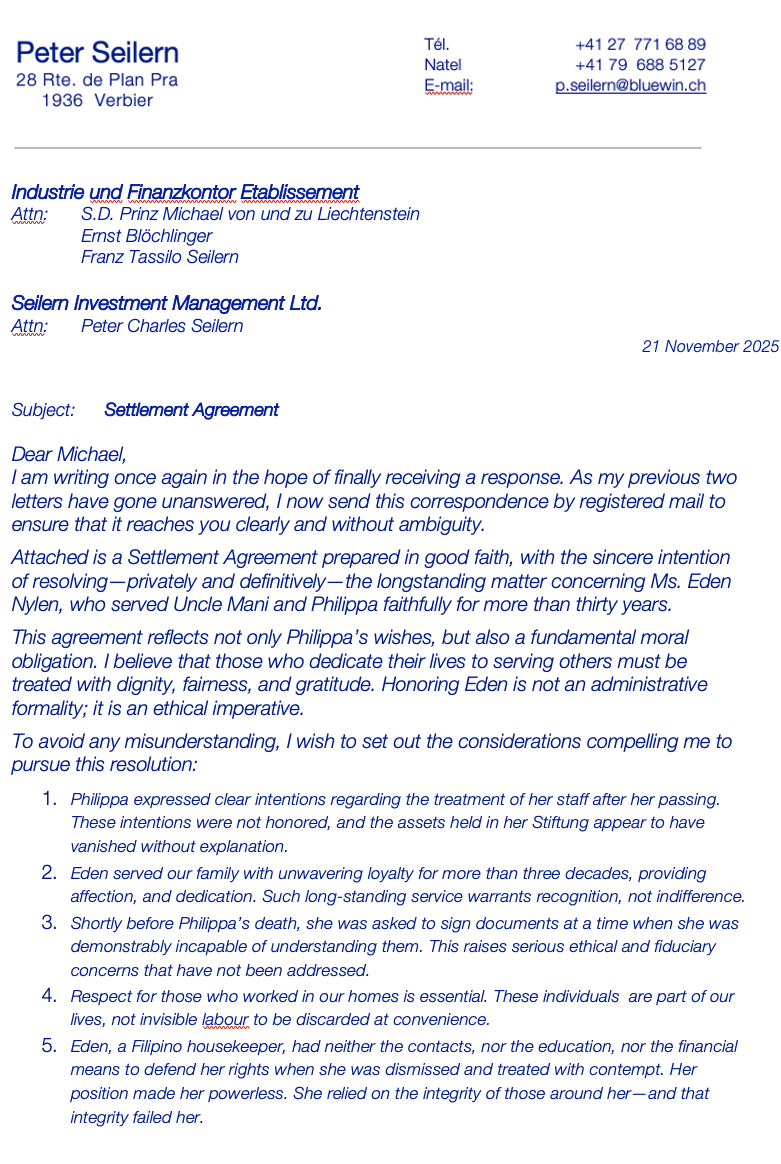
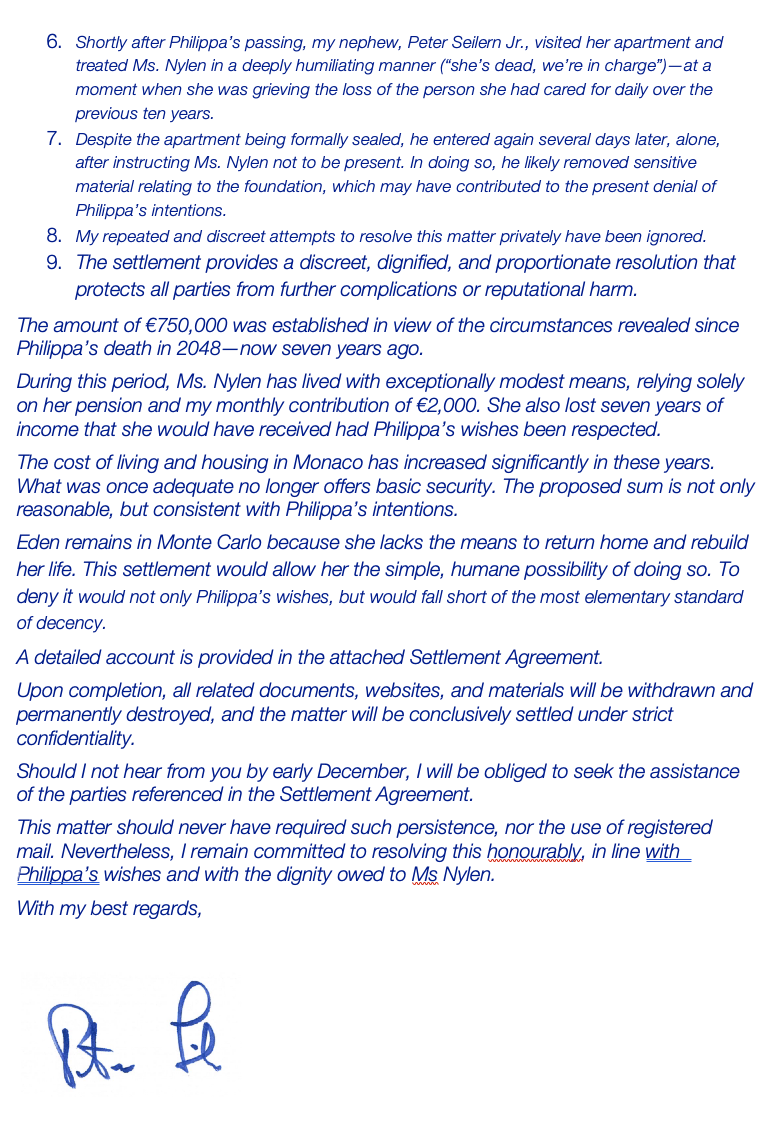
Michael L. to PS Sr. 10.12.2025

PS Sr. to Michael L. 15.12.2025


PS Sr. to Brigitte H. 08.01.2026

Frau Regierungschefin Brigitte Haas
Regierung des Fürstentums Liechtenstein
Peter-Kaiser-Platz 1
FL-9490 Vaduz
8. Januar, 2026
Sehr geehrte Frau Regierungschefin,
ich wende mich respektvoll an Sie, um Ihre Aufmerksamkeit auf die Situation von Eden Nylen zu lenken, deren Wohlergehen durch das Verschwinden der Stiftung von Philippa Seilern erheblich beeinträchtigt wurde – entgegen den klar bekundeten Absichten ihrer Gründerin.
Dieser Sachverhalt gibt Anlass zu ernster Besorgnis, dass liechtensteinische Geheimhaltungsbestimmungen möglicherweise so ausgelegt werden, dass berechtigte Aufklärung erschwert wird, anstatt den vorgesehenen Datenschutz zu gewährleisten.
Solche Regelungen sollten niemals dazu führen, Verantwortlichkeit zu verhindern oder einer schutzbedürftigen Person die ihr zugedachte Fürsorge und Würde zu versagen.
Mein einziges Ziel ist humanitärer Natur: sicherzustellen, dass Eden Nylen den letzten Abschnitt ihres Lebens in angemessener Weise verbringen kann, im Einklang mit dem ausdrücklich bekundeten Willen Philippas. Ein ausführlicher Untersuchungsbericht liegt in gedruckter Form bei. Ergänzende Unterlagen und Hintergrundmaterialien sind zudem auf der genannten Website verfügbar; die Zugangsdaten werden separat übermittelt.
Liechtensteins langjähriges Bekenntnis zur Menschenwürde, zur Rechtsstaatlichkeit und zu verantwortungsvollem staatlichem Handeln bestärkt mich in der Zuversicht, dass diese Angelegenheit mit der gebotenen Sorgfalt geprüft wird.
Ich danke Ihnen für Ihre Zeit und Hilfe.

Peter Seilern
www.philippaseilern.ch User Name: philippa
Passwort: sseilern
PS Sr. to Gisela B. 08.01.2026
I.D. Gisela Bergmann
Prinzessin von und zu Liechtenstein
Industrie & Finanzkontor Etablissement
Herrengasse 21, Postfach 339
FL 9490 Vaduz Liechtenstein
8 Januar, 2026
Geehrte Prinzessin Gisela,
Ich erlaube mir, Sie in einer Angelegenheit zu kontaktieren, die mir seit mehreren Jahren große Sorge bereitet und die das Vermächtnis meiner verstorbenen Cousine Philippa Seilern (1948–2018) betrifft.
Ich bin der Onkel von Franz Tassilo Seilern und zugleich der nächste noch lebende Verwandte von Philippa. Sollte Ihnen der Sachverhalt nicht vollständig bekannt sein, möchte ich ihn in aller Kürze und mit der gebotenen Zurückhaltung darlegen.
Nach dem Tod meiner Cousine im Jahr 2018 stellte sich heraus, dass ihre liechtensteinische Stiftung – welche von Ihrem Hause verwaltet wurde – faktisch nicht mehr existent war. Dies allein wäre kein Gegenstand dieses Schreibens, da mir bewusst ist, dass Stiftungsstrukturen rechtlich komplex sind und sich im Laufe der Zeit verändern können.
Was mich jedoch zutiefst beunruhigt, ist ein Vorgang, der sich kurz vor dem Tod meiner Cousine ereignete und dessen menschliche Konsequenzen bis heute andauern.
 Kurz vor ihrem Ableben wurde Philippa in ihrer Wohnung in Monte Carlo von Herrn Ernst Blöchlinger aufgesucht, um Dokumente zur Unterschrift vorzulegen. Zu diesem Zeitpunkt war sie bettlägerig, gesundheitlich stark eingeschränkt und vollständig auf die Hilfe ihrer langjährigen Haushälterin Eden Nylen angewiesen. Außer Frau Nylen war niemand anwesend.
In diesem Zusammenhang übergab Philippa Seilern Herrn Blöchlinger ausdrücklich die IBAN-Daten von Frau Nylen. Nach meinem Verständnis geschah dies mit dem klaren Zweck, sicherzustellen, dass Frau Nylen – die über mehr als drei Jahrzehnte treu für sie und ihre Familie gearbeitet hatte – nach ihrem Tod finanziell abgesichert würde und in Würde in ihre Heimat zurückkehren könne.
Nur wenige Tage nach dem Tod meiner Cousine wurde Frau Nylen jedoch ohne Vorwarnung aus der Wohnung entfernt, der Zugang verwehrt und sie praktisch sich selbst überlassen – allein in Monte Carlo, ohne Einkommen, ohne Unterstützung und ohne Erklärung. Dies geschah trotz ihrer jahrzehntelangen Loyalität gegenüber unser Familie.
Seit nunmehr sieben Jahren bemühe ich mich um eine angemessene, diskrete und menschlich vertretbare Lösung dieser Situation.
Was mich in dieser Angelegenheit belastet, ist nicht ein rechtlicher Aspekt, sondern der Mangel an Mitgefühl sowie die existentielle Verzweiflung, die einer einfachen, schutzlosen Haushälterin zugefügt wurden – einer Frau, deren Würde und jahrzehntelange Lebensleistung offensichtlich übersehen wurden und die weder über die Mittel noch über die Möglichkeit verfügte, sich zu verteidigen.
Es ist möglich, dass Ihnen dieser Sachverhalt in dieser Form bislang nicht oder nicht vollständig zur Kenntnis gebracht wurde, oder dass Ihnen die menschlichen Folgen dieser Angelegenheit nicht im Detail bekannt waren.
Eine angemessene Zuwendung an Frau Nylen würde lediglich einen kleinen Bruchteil des Gesamtwertes von Philippa Seilerns Stiftung ausmachen, wäre jedoch für die Betroffene von erheblicher Bedeutung.
Ich möchte klarstellen: Im Falle einer solchen Lösung werde ich sicherstellen, diese Angelegenheit endgültig als erledigt zu betrachten, ohne weitere Konsequenzen. In diesem Sinne bitte ich Sie, mir bei der Ermöglichung einer anständigen und dem erkennbar geäußerten Willen von Philippa Seilern entsprechenden Lösung zu helfen.
Für Ihre Zeit und Ihr persönliches Verständnis danke ich Ihnen im Voraus.
Peter Seilern
www.philippaseilern.ch User Name: philippa
Passwort: sseilern
Conditions
November, 2025
Purpose
This Settlement Agreement is made in good faith and with the intention of honouring the wishes of the late Philippa Seilern (1948-2018).
Its objective is to ensure that Ms Eden Nylen, Philippa's long-time housekeeper, and trusted companion, receives the financial security and dignity that Philippa intended for her.
These provisions, foreseen and expressed by Philippa during her lifetime, were never fulfilled. This settlement will restore her intentions fairly and respectfully.
Background
Following Philippa's death in January 2018, it became apparent that her estate-held within a Liechtenstein foundation administered by Industrie und Finanzkontor Etablissement (Vaduz)-had not been distributed in accordance with her wishes.
The failure to provide for Ms Nylen, who had loyally served the Seilern family for more than three decades, represents a serious moral and fiduciary lapse that this initiative aims to correct.
Identified Parties
Industrie und Finanzkontor Etablissement (IFKE)
S.D. Prinz Michael von und zu Liechtenstein, Ernst Blöchlinger, Franz Tassilo Seilern
Seilern Investment Management Ltd.
Peter Charles Seilern
Terms of Settlement
The parties shall arrange for the following payments to be made:
To Ms Eden Nylen
Address: 1, Avenue Henry Dunant, MC 98000
Amount: € 750,000 (seven hundred and fifty thousand euros).
Account: Crédit Agricole Monaco
IBAN: MC58 1910 6006 9843 6888 6789 594
To The Missionaries of Charity
Address: Feldstrasse 136, 8004 Zürich
Amount: CHF 60,000 (sixty thousand Swiss francs).
Bank: Zürcher Kantonalbank
IBAN: CH58 0070 0111 2000 3477 6
Deadline
All payments shall be executed no later than January 15, 2026.
Conditions
Upon confirmed receipt of the settlement payments:
All related websites, digital materials, and printed documents concerning this matter will be permanently withdrawn and destroyed.
The matter is thereafter deemed fully, finally and irrevocably resolved.
All parties shall maintain strict confidentiality.
Third-party proof (bank or legal professional) that all settlements have been executed.
The above Terms of Settlement are final, irrevocable, and not subject to negotiation, amendment or clarification.
Final Provision
This document is issued without prejudice to any rights, claims or remedies that may arise should no settlement be concluded.
Nothing in this document shall be construed as an admission of liability by any party.
Its purpose is to resolve the matter honourably, discreetly, and in the spirit of integrity and compassion that characterised Philippa Seilern's intentions
Miscellaneous
Banque J. Safra Sarasin (Monaco) SA


Portimo Trust reg.

Rakuira Ltd.
Note: This may have nothing to do with Philippa’s foundation. To be checked.

Gasenza Trust reg - Ayant Droit Economique

Addresses
The following two pages provide information, relating to this document.


Press, academic & legal articles relating to Liechtenstein foundations
Industrie u. Finanzkontor Etablissement

Donnerstag, 03. Dezember 2015 05:24
«Manche Kunden fühlen sich bei ihrer Bank nicht mehr heimisch»
Graf Francis von Seilern-Aspang (links) und Prinz Michael von Liechtenstein
 Von
Privatvermögen ist heute bedroht. Das stellen Prinz Michael von Liechtenstein und Graf Francis von Seilern-Aspang im Interview mit finews.ch fest und entwerfen darum eine Zukunftsvision für die Vermögensbetreuung.https://philippa-s.at/0077f497-6539-40e6-b16f-1676f1583a90" alt="pastedGraphic_1.png" />
Meine Herren, wenn von Geld die Rede ist, geht es oftmals um die Frage, wie man dieses vermehren kann. Sie hingegen wollen Vermögen «nur» erhalten und nennen das «Wealth Preservation». Weshalb so bescheiden?
Prinz Michael von Liechtenstein (PMvL): Unter dem Begriff «Wealth», also Vermögen, verstehen wir nicht nur Finanzanlagen, sondern ebenso materielle wie immaterielle Güter, etwa Immobilien, Yachten, aber auch Unternehmenswerte oder die Ausbildung von Familienmitgliedern.
Wir beraten und betreuen vermögende Familien und Unternehmer überall auf der Welt, deren Anspruch es ist, bestimmte Vermögenswerte zu erhalten, um damit einen langfristig ausgerichteten Zweck erfüllen zu können. Die Vermögensvermehrung ist dementsprechend ein Teilaspekt.
Wovor muss man Privatvermögen schützen?
Graf Francis von Seilern-Aspang (GFvSA): Private Vermögen spielen eine wichtige volkswirtschaftliche Rolle. Hinzu kommt, dass Vermögen schon immer gefährdet waren – durch Wirtschaftskrisen, Kriege und Katastrophen, aber auch durch staatliche Enteignungen oder Nachlässigkeit.
«Es besteht ein großes Risiko, dass solche Vermögen schrumpfen oder gar verschwinden»
Ungefähr 80 Prozent der kleinen und mittelgroßen Unternehmen (KMU) in Deutschland haben sich beispielsweise noch nie überlegt, wie sie ihre Nachlassplanung angehen wollen. Da besteht zwangsläufig ein großes Risiko, dass solche Vermögen schrumpfen oder gar verschwinden.
Welche Rolle übernehmen Sie in diesem Kontext?
(PMvL): Bildlich gesagt können wir eine Überschwemmung auch nicht verhindern, aber wir können dazu beitragen, einen Damm zu bauen.
Und etwas profaner ausgedrückt?
(GFvSA): Im Zusammenhang mit Familienvermögen gibt es eine Reihe von Themen, mit denen man sich ständig befassen muss: Neben der Nachfolgeregelung sind das die jeweiligen familiären Strukturen und Wertvorstellungen, die rechtskonforme Versteuerung des Vermögens, vor allem, wenn dieses über verschiedene Kontinente verteilt ist und es die Familienmitglieder möglicherweise auch sind.
«Unsere Wurzeln liegen im Hause Liechtenstein»
Mit «Wealth Preservation» haben wir vom Industrie- und Finanzkontor einen Überbegriff, der verschiedene Disziplinen in sich vereint, so dass man daraus ein Verwendungskonzept schmieden kann. Individuelle Strukturen über Stiftungen oder Trusts bilden darin das Kernelement.
Machen das nicht schon die Banken oder Family Offices?
(GFvSA): Nein. Banken und Family Offices legen ihren Fokus anders, nämlich primär auf «bankable Assets». Sie decken somit einen Teilbereich der Wealth Preservation ab.
Wie qualifiziert sich denn der relativ unbekannte Industrie- und Finanzkontor für die Wealth Preservation?
(PMvL): Wir betrachten eine Vermögenssituation in ihrer Gesamtheit, also nicht nur aus dem materiellen Blickwinkel. Den Industrie- und Finanzkontor gibt es seit 1948. Unsere Wurzeln liegen im Hause Liechtenstein, das seit vielen Jahrhunderten Bestand hat und ein Beleg dafür ist, dass Vermögen und Werte auch in einem sich ständig verändernden Umfeld erhalten und über Generationen hinweg weitergegeben werden können.
«Wie im Bauwesen sehen wir uns als Generalunternehmer»
Der Industrie- und Finanzkontor kann aus diesem reichhaltigen Erfahrungsschatz schöpfen. Wir beraten beispielsweise nicht nur darin, was man tun kann, sondern ebenso, was man besser vermeiden sollte. Das gehört auch zu unserer Verantwortung als «Wealth Preservation Experts». Mit unserem Wissen und unserer Erfahrung können wir Vermögen und Werten eine Zukunft geben.
Ist das nicht bloß ein leeres Versprechen?
(GFvSA): Nein. Der Begriff «Vermögen» beinhaltet ja auch die Konnotation, wonach man etwas «vermag» also etwas kann, was wiederum sehr viel mit Erfahrung, Kompetenz und Verantwortung zu tun hat. Mit unserem Verständnis zeigen wir unseren Kunden ihre Möglichkeiten realistisch auf.
Wie im Bauwesen sehen wir uns dabei als Generalunternehmer, der je nach Bedarf die erforderlichen Spezialisten beizieht, damit ein Vermögen über Generation erhalten bleibt.
Wo stellen sich die größten Hindernisse bei dieser Aufgabe?
(PMvL): Die Ansprüche einer Familie verändern sich über die Zeit, ebenso wie die externen Rahmenbedingungen. Heute besteht ein regulatorisches Korsett, das den Einzelnen stark einschränkt, um mit seinem Vermögen frei zu handeln.
«Traditionelle Familienmuster sind aufgebrochen»
Rückblickend muss man auch feststellen, dass eine Epoche der finanziellen Übertreibungen zusammenbricht. Nun versuchen gewisse Staaten alles daran zu setzen den Weg in eine vermeintliche Normalität mit vielen neuen Gesetzen zu säumen.
Was ist daran schlecht?
(PMvL): Die daraus resultierende Komplexität, sei dies bei Haftungsfragen, im Erbrecht oder bei Steuerthemen, stellt heutzutage insbesondere ehr und redliche Leute vor große Probleme. Zugleich sind traditionelle Familienmuster aufgebrochen, was die Rechtssituation zusätzlich erschwert.
Schließlich muss man feststellen, dass selbst in der Schweiz nicht mehr nur das schweizerische Recht gilt. Wir brauchen eine Normalität in Form von einer überschaubaren Anzahl von Gesetzen.
Sie haben von einer neuen Normalität gesprochen. Wo stehen wir diesbezüglich auf der Zeitachse?
(PMvL): Wir stehen noch nirgends, wenn man sich die derzeitige Gesetzeslage anschaut. Und wie diese morgen aussehen wird, steht in den Sternen. Gerade das ist auch ein Indiz dafür, dass Privatvermögen bedroht ist. Denn ohne eine überschaubare Gesetzeslage können Gesetze auch nicht eingehalten werden.
Warum denn nicht?
(PMvL): Weil die Verhältnismäßigkeit fehlt. Oder anders gesagt: Der Respekt vor dem Gesetz fehlt, wenn keine Normalität existiert. Man hat zwar allmählich schon das Gefühl, dass es mit dieser übertriebenen Political Correctness und der Gesetzes- und Verordnungsflut nicht so weitergehen kann. Doch kaum jemand unternimmt etwas dagegen.
Warum sollte ausgerechnet Liechtenstein ein Standort für die Vermögenserhaltung sein?
(GFvSA): Liechtenstein ist nicht die einzige Jurisdiktion auf der Welt, die Stiftungen und Trusts anbietet. Doch hierzulande existiert eine lange Tradition von Vermögenssicherung. Ein wesentlicher Grundstein wurde im Jahr 1926 gelegt, als der Gesetzgeber die ersten Vermögensstrukturen dieser Art ermöglichte.
«Die angestrebte Transparenz kommt einem Eingriff in die Privatsphäre gleich»
Es ist in diesem Zusammenhang auch wichtig, dass Trusts und Stiftungen aus familiären, gemeinnützigen oder wohltätigen Absichten heraus entstanden sind. Liechtenstein bietet stabile politische Verhältnisse, ein verlässliches Rechtssystem und verfolgt keine geopolitischen Eigeninteressen.
In den vergangenen Jahren wurde das Fürstentum auch in diverse Skandale verwickelt. Das hat den Finanzplatz erschüttert. Spätestens seit dann stehen Trusts und Stiftungen unter Generalverdacht. Ist nicht zu befürchten, dass der «Sonderfall Liechtenstein» genauso erodiert wie das Schweizer Bankgeheimnis?
(GFvSA): Medial lastet zweifelsohne Druck auf Stiftungen und Trusts. Diese Rechtsinstrumente wurden ursprünglich aber nicht in der Absicht entwickelt, um Steuern zu hinterziehen, sondern um Vermögen zu schützen, um damit einen langfristigen Zweck zu erfüllen.
Es gibt keinen Grund, dies zu verpönen. Selbst unter dem Deckmantel der heute oft bemühten Transparenz läuft eine solche Argumentation ins Leere. Die angestrebte Transparenz kommt einem Eingriff in die Privatsphäre gleich.
Besteht aber nicht die Gefahr, dass Liechtenstein auf Grund seiner Kleinräumigkeit unter einen Großen internationalen Druck gelangen könnte?
(GFvSA): Weltweit existieren vermutlich etwa 50 Jurisdiktionen, die Trusts und Stiftungen anbieten. Insofern ist das nicht ein Privileg Liechtensteins. Entsprechend wird man solche Vermögensstrukturen nicht so leicht abschaffen können. Es gibt keine begründbare Handhabe dafür.
Außer als Stiftungszentrum profiliert sich Liechtenstein neuerdings als Standort für Datensicherheit. Ist das die große Zukunftsperspektive für einen Kleinstaat?
(PMvL): Das Thema steht noch ganz am Anfang. Aber es ist wichtig. Ich habe kürzlich in der Zeitung gelesen, Daten seien «das Gold des 21. Jahrhunderts». Das unterstreicht, wie wichtig Datensicherheit heute geworden ist.
«Liechtenstein ist als Standort für Datensicherheit ein Zukunftsmodell»
Ich denke, der systematische Schutz von Daten wird tatsächlich eine der ganz Großen Herausforderungen des 21. Jahrhunderts sein.
Inwiefern denn?
(GFvSA): Haben Sie sich nicht auch schon gewundert, wie manche Staaten sich gegenüber Bürgerinnen und Bürger verhalten? Garantieren sie stabile Rechtsverhältnisse, sind sie verlässlich und stellen die Rahmenbedingungen, innerhalb denen sich Bürger frei bewegen können? Oder sind sie eher von Eigeninteressen getrieben, misstrauen den Landsleuten und sehen diese als bloßes Vermögenssubstrat?
(PMvL): Vor diesem Hintergrund ist es nicht ausgeschlossen, dass Länder mit einer hohen Kriminalitäts- und Korruptionsrate den geplanten internationalen Informationsaustausch (AIA) als probates Marktforschungs-Instrument missbrauchen. Insofern ist Liechtenstein als Standort für Datensicherheit ein vielversprechendes Zukunftsmodell – weil solche Missbräuche hierzulande weitgehend ausgeschlossen werden können.
Nach Ihren Worten wird der AIA zu wenig kritisch hinterfragt?
(PMvL): Bestimmt. Ich möchte an dieser Stelle nichts pauschalisieren. Aber es gibt auf dieser Welt einige Länder, bei denen man sich durchaus fragen darf, ob sie den AIA tatsächlich gewissenhaft einhalten werden. Länder, wo Kidnapping, Erpressungen und Mord an der Tagesordnung sind.
Neben der Transparenz durch den AIA bedroht noch eine andere Entwicklung den «Alltag» der Banken. Es ist der technologische Fortschritt, der zur Folge hat, dass viele Finanzgeschäfte in die virtuelle Welt abwandern. Nehmen Sie diesen Trend wahr?
(PMvL): Ja, wenngleich die individuelle Beratung und Betreuung von vermögenden Familien und die digitale Welt zwei Paar Schuhe sind. Doch gerade mit dem Internet neigen viele Finanzinstitute dazu, ihre Kunden oder Dienstleistungsempfänger noch stärker zu segmentieren, und darin lauert ein enormes Gefahrenpotenzial.
«Was muss man als Kunde alles preisgeben?»
Auch muss man sich dabei fragen: Was muss man als Kunde alles preisgeben, in diesem Wechselspiel von Transparenz und Privatsphäre? Man sollte sich wieder vermehrt ins Bewusstsein rufen, dass die Finanzindustrie ein People’s Business ist und bleibt.
Es ist jedoch eine Tatsache, dass für immer mehr Finanzgeschäfte Banken gar nicht mehr nötig sind. Werden sie dereinst ganz überflüssig sein?
(PMvL): Ich sehe verschiedene Entwicklungen: Die Banken werden zunehmend gezwungen – auf Grund von Gesetzen und Bestimmungen – ihre Kunden zu kategorisieren. Das führt dazu, dass sich manche Kunden bei ihrer Bank nicht mehr heimisch fühlen und deshalb auch eher bereit sind, zu einem anderen Institut zu wechseln.
Wenn sie manche Bankgeschäfte online tätigen können, werden sie das zweifelsohne tun – bis hin zum Crowdfunding. Je mehr die Finanzinstitute durchorganisiert sind, desto eher werden sie einem EDV-Netzwerk gleichen. Das wird die individuelle Beratung in Finanzangelegenheit massiv beeinträchtigen.
Was sind Ihre nächsten Schritte?
(GFvSA): Hinauszugehen und die gute Nachricht zu verkünden. Spaß beiseite. Mir scheint es wichtig, aufzuzeigen, dass es eine Notwendigkeit dafür gibt, die verschiedenen Teilbereiche, die eine Vermögensstruktur betreffen, zusammenzuführen und diese gesamtheitlich zu betrachten – unter dem Oberbegriff «Wealth Preservation».
«In einem Umfeld von Veränderungen ergeben sich oftmals die besten Chancen»
Auf der Welt leben Menschen, die tagtäglich feststellen müssen, dass ihr Vermögen bedroht ist. Die Rahmenbedingungen sind nicht überall so gut wie in Liechtenstein und der Schweiz.
Sie erwähnen in Ihrem Haus gelegentlich den Grundsatz «Never miss a crisis». Was bedeutet das?
(PMvL): Dass man Krisen nicht verhindern, aber zumindest manchmal entscheiden kann, wie man damit umgeht. In einem Umfeld von Veränderungen und Unsicherheiten ergeben sich oftmals die besten Chancen. Denn, wenn alles perfekt läuft, sieht niemand den Bedarf, etwas zu verändern, im Sinne von weiterentwickeln.
In Krisen sollte man folglich nicht verzweifeln, sondern sie als Chancen wahrnehmen, um manche Dinge besser zu machen, sich selbst weiter zu entwickeln und das Gute erhalten zu können.
In der Serie «Eine Zukunftsvision für die Vermögensbetreuung» beleuchten Repräsentanten von Industrie- und Finanzkontor Ets., Vaduz, den «Wealth-Preservation Ansatz» aus verschiedenen Perspektiven.
Industrie- und Finanzkontor Etablissement, gegründet 1948 und domiziliert in Vaduz, ist ein unabhängiges, liechtensteinisches Treuhandunternehmen mit internationaler Ausrichtung und beschäftigt rund 50 Mitarbeitende. Das Unternehmen ist spezialisiert auf den langfristigen und generationenübergreifenden Vermögenserhalt (Wealth Preservation), insbesondere von Familien und Unternehmern.
Der 64-jährige S.D. Prinz Michael von und zu Liechtenstein ist Chairman des Industrie- und Finanzkontors sowie Gründer und Chairman des in Vaduz ansässigen geopolitischen Informations- und Beratungsdienstes Geopolitical Information Service sowie Präsident des Stiftungsrates des liberalen Think Tanks European Center of Austrian Economics Foundation in Vaduz.
Der 61-jährige Graf Francis von Seilern-Aspang ist geschäftsführender Verwaltungsrat und CEO des Industrie- und Finanzkontors, Mitglied des Verwaltungsrats von Gepolitical Information Service sowie Seilern Investment Management, London.
Fürstliche Geschäfte
Liechtenstein hat sich vom Schwarzgeld verabschiedet. Dafür schaden jetzt Treuhänder der Reputation des Landes.
Dienstag 23. Januar 2018 10:19 von René Zeyer, (Basler Zeitung)
Die Wege sind kurz. Im Fürstentum Liechtenstein kennt jeder jeden, auch in der verschwiegenen Finanzbranche – und nicht immer zum Vorteil der Kunden.
Letzten Freitag kämpfte Ralf H.* vor dem Fürstlichen Landgericht in Vaduz im Verhandlungssaal 3 um rund 3,5 Millionen Euro, die er zurückhaben möchte. Er hatte dieses Geld seiner eigenen Gesellschaft als Darlehen gegeben. Da seine Treuhänder sämtliche Verbindungen von H. zu seinen Firmen kappten, wurden ihm Einsichtsmöglichkeiten in deren Buchhaltung verweigert und der Zugriff auf sein Vermögen komplett entzogen, so sein Vorwurf. Er ist nicht der Einzige, der sich darüber beschwert, dass liechtensteinische Treuhänder durch Misswirtschaft Vermögen vernichten oder sich an der Verwaltung über Gebühr bereichern.
So machte vor Kurzem der Fall einer 2015 verstorbenen «Grande Dame» und Erblasserin Schlagzeilen, deren Erben sich über mangelnde Information und Vermögensverschleuderung durch die das Erbe verwaltende Liechtensteiner Stiftung beklagen. Eine in Vaduz eingereichte Strafanzeige wurde «mangels Anfangsverdacht» nicht angenommen, eine Zivilklage würde mit ungewissem Ausgang Jahre dauern.
Vorteil als Nachteil
Das Fürstentum hat sich im Steuerstreit mit den USA und der EU viel geschickter als die Schweiz verhalten und sein Image kräftig und schnell aufpoliert. Innerhalb weniger Jahre wurde Liechtenstein vom Steuerhinterzieherparadies zum Musterknaben der Steuerehrlichkeit. Anders sieht es aber bei der Haupteinnahmequelle der Treuhänder im Ländle aus: juristische Konstruktionen wie Stiftungen oder Trusts. Zwar schrumpfte die Zahl der Stiftungen von über 50 000 im Jahre 2008 auf knapp 16 000 Ende 2016: ein Aderlass durch den Abfluss von Schwarzgeld.
Ihr Vorteil ist gleichzeitig auch ihr Nachteil: Die Identität des Stifters kann hinter den verwaltenden Stiftungsräten verschwinden. Im schlimmsten Fall aber auch seine Kontrolle über das Stiftungsvermögen. So kritisierte der österreichische Anwalt David Christian Bauer im Lokalblatt Vaterland, dass «die Instrumente der Stiftung immer öfter weniger an den Interessen des Gründers und der Begünstigten ausgerichtet werden».
Insgesamt 378 Treuhänder und Treuhandgesellschaften teilen sich das Big Business der Verwaltung von geschätzten 20 Milliarden Franken an Stiftungsvermögen. Von der Errichtung eines solchen Konstrukts über die Verwaltung und Beaufsichtigung als Stiftungsrat fallen fette Gebühren und Kommissionen an. Wie Bauer ebenfalls kritisiert, werden zudem Substiftungen errichtet, in die Vermögenswerte ausgelagert werden, über deren Verwendung weder der Stifter noch die Begünstigten Kenntnis haben. Nachdem nun kaum mehr Schwarzgeld im Ländle verwaltet wird, ärgern sich aber viele Kunden von Finanzintermediären und Treuhändern schwarz.
Nach fürstlicher Rechtsprechung sind Stiftungsräte und Treuhänder nur sehr beschränkt auskunftspflichtig gegenüber den Kapitalgebern oder den Begünstigten. Zudem muss man ihnen über Ermessensentscheidungen hinausgehende «schwere Pflichtverletzung» nachweisen, um sie abzusetzen oder haftbar zu machen. Aber wie soll das ohne Informationen gehen?
Auch Professor Martin Schauer, der die Liechtensteiner Regierung bei der Reformierung des Stiftungsrechts beriet, kritisiert in Vaterland «Rechtsunsicherheit» für den Begünstigten und Mandatsverträge als «willkommenes Mittel für Haftungsbefreiung». Immer häufiger und oft vergeblich kämpfen Stifter juristisch gegen ihre eigenen Stiftungsräte oder Treuhänder. Nicht selten fällt dabei der Name Angelika Moosleithner-Batliner.
Über Jahrzehnte dominierte Herbert Batliner das liechtensteinische Treuhandgeschäft. Seine Karriere endete eher unrühmlich, weil er die Zeichen der Zeit nicht erkannte: Ein Verfahren der deutschen Staatsanwaltschaft wegen Beteiligung an Steuerhinterziehung in Höhe von 250 Millionen Euro wurde 2007 gegen eine Zahlung von 2 Millionen Euro eingestellt. Und der Liechtensteiner Staatsgerichtshof, dem Batliner einst selbst vorstand, qualifizierte in einem Urteil von 2009 Zuwendungen aus einer Stiftung an Batliner als «sittenwidrige Geschäfte».
Die Familientradition wird von seiner Tochter Angelika Moosleithner-Batliner fortgeführt. Sie ist Mitbesitzerin der in First Advisory umbenannten Batliner-Firma. Im Jahr 2009 schluckte First Advisory zudem die LGT-Treuhand; die Fürstenbank LGT zog sich damals aus dem ins Feuer geratenen Treuhandgeschäft zurück. Heute ist First Advisory mit über 240 Mitarbeitern und Vertretungen in Genf, Zürich, Hongkong, Panama und Singapur der Platzhirsch unter den Finanzdienstleistern im Ländle.
Auf grossem Fuss
Im aktuellen Prozess des Schrotthändlers Ralf H. ist Moosleithner-Batliner beklagte Partei. Sie ist unter anderem Verwaltungsrätin von H.s Gesellschaften. Der wegen Steuerdelikten vorbestrafte Ralf H., der einige Jahre in der Schweiz in einer Villa am Vierwaldstättersee auf grossem Fuss lebte, wirft First Advisory und der Verwaltungsrätin seiner Firmen, Moosleithner-Batliner, vor, sie hätten keine ordentliche Buchhaltung geführt und so seine Steuerprobleme verursacht.
Der Pressesprecher von First Advisory entgegnet, dass diese «Vorwürfe von Herrn H. sachlich völlig entkräftet» seien. «Zu seiner Verteidigungsstrategie gehörte in den vergangenen Jahren seit 2008, unschuldigen Dritten, darunter auch liechtensteinischen Treuhändern und Anwälten, mit unterschiedlichsten Vorwürfen unzulässigerweise die Schuld für seine Situation zuzuschieben, um seine Alleinverantwortung für den Mehrwertsteuerbetrug in Abrede zu stellen.» Im aktuellen Prozess steht das Urteil noch aus. Ganz anders in einem anderen Fall.
Im November 2017 erschütterte der Fall des Treuhänders Harry G.* die gesamte Zunft in Liechtenstein. Der «fürstliche Justizrat» war viele Jahre Präsident des Verwaltungsgerichts und bis 2004 sogar Präsident des Staatsgerichtshofs, des Verfassungsgerichts. Der Chef der Prüfungskommission für Treuhänder und Rechtsanwälte wurde vom Kriminalgericht Vaduz wegen «gewerbsmässig schweren Betrugs und Geldwäsche» sowie der Veruntreuung von 13 Millionen Franken verurteilt.
Da G. lediglich gegen die Höhe des Strafmasses von sechs Jahren Berufung einlegte, ist das Urteil rechtskräftig. Spätestens seit diesem Skandal ist klar, dass im Eldorado der Liechtensteiner Treuhänder, die sich als Stiftungsräte goldene Nasen verdienen, Feuer im Dach ist. Und der nächste Prozess in dieser Causa ist noch anstehend, insgesamt soll es um über 50 Millionen Franken gehen.
Bei immer noch 16 000 Stiftungen, die jeweils über mindestens drei Stiftungsräte verfügen müssen, entfallen auf die rund 100 Treuhänder 480 Stiftungsmandate pro Nase. Selbst wenn nicht zu kriminellen Mitteln gegriffen wird: Pro Stiftung werden Kosten von mindestens 4000 Franken für die Gründung, 5000 Franken für den jährlichen Betrieb in Rechnung gestellt. Plus Beratungskosten nach Aufwand zu einem Ansatz von bis zu 500 Franken pro Stunde. Macht pro Stiftungsrat ein Jahreseinkommen von 800 000 Franken.
Allgemein wird geraten, erst ab einer Einlage von mindestens 1,5 Millionen Franken eine Stiftung zu gründen. Da die Stiftungsräte dem Stifter und erst recht den Begünstigten gegenüber nur sehr eingeschränkt auskunftspflichtig sind, existiert zudem eine Grauzone, welche Gebühren oder Kick-backs sich die Stiftungsräte bei der Verwaltung des Vermögens abgreifen. Immer wieder gibt es Fälle, in denen Begünstigte nach dem Tod des Stifters Auskunft über die Bewirtschaftung des Vermögens verlangen – und auf den ordentlichen Rechtsweg verwiesen werden.
Im Ländle mit seinen 38 000 Einwohnern sind alle Wege kurz und kennt jeder jeden. So ist Angelika Moosleithner Präsidentin der Liechtensteinischen Treuhandkammer, im Vorstand sitzt neben Seiner Durchlaucht Prinz Michael von und zu Liechtenstein auch Johannes Gasser. Dieser Anwalt war einst Partner von Batliner senior, führt als Gasser Partner die Geschäfte weiter und ist für Moosleithner-Batliner der Rechtsvertreter ihrer Wahl.
Dabei schadet es sicher nicht, dass Gasser im Richterauswahlgremium sitzt; er bestimmt also mit, welche Richter seine Fälle behandeln. Der Sache der Finanzintermediäre nicht abträglich ist zudem die Tatsache, dass Anwälte und Treuhänder nebenamtlich als oberste Richter im Fürstentum arbeiten dürfen. Auf Anfrage hält Gassers Pressesprecher dagegen: «Die Gerichte selbst entscheiden unabhängig und souverän über die gerichtsinterne Zuteilung der Fälle. Darauf hat niemand Einfluss, auch nicht das Richterauswahlgremium oder Dr. Gasser.»
Inzwischen formiert sich Widerstand gegen die Vertreter der Treuhänder-Zunft, die gerne ihre fetten Pfründen behalten möchten. Der Liechtensteiner Treuhänder Roger Frick wandte sich im Oktober letzten Jahres an seine «werten Kollegen» in der Treuhandkammer und berichtete über zunehmende Klagen aus dem Ausland, dass es «in Liechtenstein immer mehr Finanzintermediäre gebe, die Mandate blockierten, Steuerbereinigungen nicht zuliessen und gleichzeitig die Honorare erhöhten». Das käme durchaus auch «als Erpressung» daher. Die feste Bindung des Mandanten an seinen Treuhänder laufe «auf einen Selbstbedienungsladen hinaus», das schade dem Finanzplatz.
Als Abhilfe schlägt Frick vor, dass zumindest die Übertragung eines Mandats von einem Treuhänder auf einen anderen für den Mandanten deutlich erleichtert und kostenfrei gestaltet werden soll. Darauf reagierten Moosleithner-Batliner und Gasser blitzartig mit einem eigenen Schreiben, in dem sie die Kollegen darum baten, von einer Unterstützung des Anliegens von Frick «Abstand zu nehmen». Allfälligen Empfehlungen des Vorstands der Treuhandkammer sei nicht vorzugreifen.
50 Milliarden aus der Schweiz
Im Steuerstreit hat sich das Fürstentum Liechtenstein elegant aus der Bredouille befreit und sein Image aufpoliert. Geldgierige Treuhänder und Stiftungsräte sorgen nun für einen zunehmenden Reputationsschaden. Während früher der Hinweis auf Schwarzgeld die Kapitalgeber bei Stiftungen davon abhielt, gegen ihre eigenen Stiftungsräte und Treuhänder vorzugehen, wenn die zu geldgierig wurden, sind es heute schlichtweg gesetzliche Hürden. Sie machen es im Zweifelsfall für den Stifter oder für die Begünstigten fast unmöglich, Auskünfte zu erlangen und Stiftungsorgane in Haftung zu nehmen.
Von den insgesamt 235 Milliarden Franken verwaltete Vermögen in Liechtenstein stammen rund 50 Milliarden aus der Schweiz. Einige werden noch vor dem Inkrafttreten des automatischen Informationsaustausches in diesem Herbst abgezogen werden. Ist das Vermögen allerdings in einer Stiftung parkiert, dürfte das nicht einfach werden.
* Name der Redaktion bekannt
Quelle: Basler Zeitung
Droht Liechtenstein ein Exodus der Stiftungen?

Das Fürstentum gilt als Top-Standort für Privatstiftungen. Es ist aber eine Debatte über Fehlentwicklungen entbrannt.
Christine Kary 31.01.2018
Wien. Hält der Stiftungsstandort Liechtenstein nicht mehr, was er verspricht? Knapp zehn Jahre, nachdem dort das Stiftungsrecht reformiert wurde, ist darüber eine heftige Diskussion entbrannt. "Unzufriedene Stimmen häufen sich «, sagt Rechtsanwalt David Christian Bauer, Country Managing Partner im österreichischen Büro von DLA Piper. So mancher Mandant überlege bereits, dem Standort den Rücken zu kehren. "Und wenn die Absetzbewegung einmal Fahrt aufnimmt, ist sie nicht mehr zu stoppen. « Das betreffe auch österreichische Unternehmer und Familien - gerade für diese habe der Standort Liechtenstein an sich große Bedeutung.
Was ist der Grund für das Unbehagen? An der Rechtslage liege es nicht, sagt Bauer. Ganz im Gegenteil - das liechtensteinische Stiftungsrecht biete erfreuliche Flexibilität und Rechtssicherheit. Vielmehr gehe es um Fehlentwicklungen bei der Anwendung: "Wenn das Instrument im Eigeninteresse von Verwaltern eingesetzt wird, versagen seine positiven Eigenschaften. «
An und für sich ist Liechtenstein ein höchst attraktiver Standort für Stifter. Nicht mehr aus steuerlichen Gründen - Liechtenstein nimmt inzwischen am Informationsaustausch teil. Die Zahl der dort ansässigen Stiftungen hat sich seither stark reduziert: Über 50 000 seien es im Jahr 2008 gewesen, nur noch knapp 16 000 Ende 2016, berichtet die Basler Zeitung«. Diejenigen, die geblieben sind, schätzen jedoch das dortige Rechtsregime: Dieses gesteht Stiftern und Begünstigten weitgehende Einflussrechte zu - anders als in Österreich.
Muss der Gesetzgeber eingreifen?
Laut Bauer häufen sich in der Praxis jedoch die Beschwerden:
Eingriffsrechte von Stiftern würden nur halbherzig beachtet, Begünstigten nichtssagende Auskünfte gegeben, einzelne Familienstämme grundlos bevorzugt. Es würden sogar Stiftungen ohne Begünstigte fortgeführt, die im Wesentlichen nur noch Stiftungsorganen und Beratern ein Einkommen verschaffen. Auch suboptimale Vermögensveranlagung komme vor. Und selbst die Gerichte würden manchmal Anlass für Unmut geben - etwa, wenn Abberufungen von Stiftungsräten viel zu lange dauern.
Ein Artikel, den Bauer darüber in einer liechtensteinischen Zeitung ("Liechtensteiner Vaterland H) geschrieben hat, heizte die Debatte an. Es gab positive Reaktionen, aber auch scharfe Kritik: Die Liechtensteinische Treuhandkammer ortete einen Versuch, dem Ruf des Finanzplatzes zu schaden. Bauer verwahrt sich dagegen: Er sorge sich über Entwicklungen, die den Standort gefährden könnten. Es liege an der Beratungsbranche und den Gerichten, ihre Kontrollmechanismen zu schärfen, und nötigenfalls am liechtensteinischen Gesetzgeber, "gewisse Unklarheiten und Wildwuchs H zu beseitigen.
An diesem Punkt hakt Martin Schauer ein, Professor für Zivilrecht an der Uni Wien. Er hat an der Reform des liechtensteinischen Stiftungsrechts als Regierungsberater mitgewirkt. „Eine Zwischenbilanz knapp zehn Jahre nach Inkrafttreten fällt gemischt aus“ konstatiert er heute. Das Gesetz habe einen "beachtlichen QualitätssprungH gebracht, der Erfolg hänge nun aber auch von einer "schrittweisen Bewusstseinsänderung für die Bedürfnisse eines modernen Finanzplatzes“ ab.
Zudem schlägt er - ebenfalls in einem Artikel im „Vaterland" - legistische Verbesserungen vor: Es fehle etwa an einer klaren Rechtsnorm, wonach (potenziell) Begünstigte über ihre Rechtsstellung zu informieren sind. Wenn sie aber nichts davon wissen, gehen auch ihre Informationsrechte ins Leere.
Kritik übt er zudem an den sogenannten Mandatsverträgen - das sind neben den Stiftungsdokumenten bestehende Vereinbarungen mit dem Treuhandunternehmen, die dem Stifter Weisungsrechte für die Verwaltung der Stiftung einräumen. Laut Judikatur habe das Stiftungsräten ermöglicht, sich weitgehend von ihrer Verantwortlichkeit und Haftung zu befreien, sagt Schauer. „In einem modernen Stiftungsrecht sollte dafür kein Platz sein."
("Die Presse", Print-Ausgabe, 01.02.2018)
Case Involving a Liechtenstein Trust
A piece for the Independent website features a case currently being worked on by Steven Kay QC. It concerns a woman called Tamar Perry, who is involved in legal proceedings against a trust company based in Liechtenstein: the Lopag Trust. The article itself focuses on Liechtenstein’s role as a tax haven.
 Ms Perry and her family have been unable to gain access to their fortune in the trust that was settled by her late father, an Israeli tycoon. Ms Perry believes the principal trustee: Dr Dieter Neupert, a Swiss lawyer, is responsible. Furthermore she suspects the directors of Lopag: Louis Oehri and Dominik Naeff to also be involved. According to the article Neupert denies the allegations and the Lopag Trust have been limited in their responses to the claims.
The Liechtenstein court has concluded that neither Tamar Perry nor the other beneficiaries have any legal rights. Taking this into account, Ms Perry has secured the services of Steven Kay QC to help in her proceedings against Dieter Neupert, Oehri and Naeff.
Ms Perry told the Independent that: “I just want to warn people that if they are thinking of placing their assets in a trust registered in Liechtenstein, then they should run away as fast as possible because they will find that the trustees will become the beneficiaries.”
“Then the judge and Liechtenstein Trust committee will take the side of the trustees. I’m sure I’m not the only one who has been set up in this way but I intend to be the last one. The lesson here is that you cannot always trust the trustees,” she added.
The article can be read in full on the Independent website, by accessing the link below:
Alexander Kay, March 9, 2018
Stealing The Assets of Dead Clients
Liechtenstein’s Modern Day Grave Robbers
In the early 1990s, Information Technology specialist Klaus Lins claimed to have discovered evidence that a Liechtenstein fiduciary was misappropriating the assets of wealthy clients when they died, instead of distributing them to beneficiaries. Lins turned whistleblower but the only person who went to prison was him, for data theft.
He also lost his home and his wife and he has since passed away. When one German beneficiary turned up at the fiduciary’s office in Liechtenstein, she was allegedly fobbed off with lies.
More recently, the family of Israeli tycoon Israel Perry has been waging a bitter legal war against a trust company in Liechtenstein in a so-far vain attempt to gain access to the deceased’s vast fortune.
At the upcoming OffshoreAlert Conference in London, British international criminal lawyer Steven Kay QC and European fraud investigator Marc Hürner will present evidence of questionable practices by Liechtenstein-based offshore service providers and discuss remedies.
The 7th Annual OffshoreAlert Conference Europe will take place at the Grange St. Paul’s Hotel, in London, on November 12-13th, 2018
Are Trustees Misappropriating Assets When Clients Die & What Are The Remedies?
This session will look at allegations of impropriety against Liechtenstein-based fiduciaries, whether a culture of criminality exists in the jurisdiction, and potential legal remedies for beneficiaries who suspect they have been swindled.
Speakers
“Inside Liechtenstein: Are Trustees Misappropriating Assets When Clients Die & What Are The Remedies?” is one of 17 sessions taking place at the 7th Annual OffshoreAlert Conference Europe on 12-13 November in London.
What is a Foundation (Stiftung)?
The Foundation replaced a Trust in popularity in Liechtenstein and is based upon a statute incorporating it - that the original settlor should approve. The statute gives total control of all assets transferred by the settlor to the board of the Foundation (Stiftungsrat).
Once an object has been transferred to a Stiftung it becomes impossible to find out who the real owner is. This information is contained in the Statuten and Bei-Statuten and only available to the Stiftungsrat. Without oversight, the Stiftungsrat can do whatever he (she) pleases and is accountable to no one.
In Liechtenstein law this has been approved and discretionary beneficiaries have no rights.
A dangerous form of tax avoidance.
Ever since Philippa died there has been no way to determine what fate awaits her estate. Worse still, it could be in the process of being surreptitiously sold off or transferred elsewhere.
I do not know for sure if this is the case, but until I see otherwise it remains a distinct possibility.
This is not an isolated situation. Die Presse, 31 January 2018 and the Independent, Thursday 8 March 2018 partially explain the problem.
Overview of Liechtenstein Foundations
1. A Liechtenstein Foundation holds assets transferred by its founder/settlor that become assets of the Foundation. The articles or statute of the Foundation set out the terms upon which the founder has transferred his assets. The founder may reserve rights in the statute: to revoke the Foundation; or amend the Foundation documents; or change the beneficiaries. The object of the Foundation is to follow the intentions of the founder as set out in the statute.
2. The Foundation is an entity without shareholders but established as a financial structure with a board of governors as a council. At least one member of the Foundation council must have a law office address registered in Liechtenstein. Foundations are required to be audited and trustees, trust companies auditing firms and chartered accountants can act as auditors.
3. The Foundation must have a purpose, that may include a class of beneficiaries. The rights of beneficiaries are regulated in the articles or statute and will include conditions for the application of the assets of the Foundation for their benefit as well as any conditions prerequisite for the loss of those rights.
4. Beneficiaries of the Foundation inherit the beneficial interest, not the heirs of the deceased beneficiary. By such means the assets remain in the Foundation. If a beneficial interest is to be inherited, it has to be expressly provided for in the Foundation documents. As a beneficiary only in life, the beneficial interest does not enter the estate of a deceased.
5. If there are no beneficiaries identified in the statute, the Foundation is solely for the benefit of the founder. In such circumstances, upon death the Foundation is transferred under inheritance laws to his estate.
6. There are distinct classes of beneficiaries:
I. Beneficiaries of the beneficial interest: benefit from the Foundation‘s assets as defined by the statute.
II. Beneficiaries of prospective entitlements: benefit from the Foundation's assets upon succession rights.
III. Discretionary beneficiaries: benefit from the Foundation's assets interest at its discretion. Discretionary beneficiaries have no rights against the Foundation.
IV. Ultimate beneficiaries: benefit from the remaining assets of the Foundation if provided for under the statute after its liquidation.
7. The private-benefit Foundation in Liechtenstein is used for the support of a particular family or class of people and ensures the transfer of assets from one person to the next generation. The founder can bind descendants to conditions upon which they may receive financial support and benefit from assets.
8. Private-benefit Foundations are not subject to external supervision and do not have to be entered into the Liechtenstein Commercial Registry (Public Registry). The Foundation deed is not deposited at the Registry of Deeds and Public Registry, only notice of its existence need be given. The founder and object of the foundation only needs to be disclosed to the Liechtenstein lawyer and the trustee. There is also no obligation to disclose the beneficiaries of the Foundation to the Liechtenstein authorities. Assets transferred into a Foundation and wealth distributed to beneficiaries is tax exempt. Inheritance tax and gift tax have also been abolished.
Conclusion
9. The conclusion from this review of Liechtenstein Foundations, is that it is a financial entity, cloaked in secrecy, and any settlor needs to enter into such arrangements with their eyes wide open and must be independently advised. The conflicts of interest that are apparent from such arrangements are obvious as the governors of the Foundation stand to gain from their supervisory role, although they are shielded from scrutiny. Once a settlor passes away, his family and potential heirs are open to embezzlement and profiteering as the power over the assets lies with the governors.
Steven Kay QC
6 October 2018
Vermögensverwaltungsgesellschaften
Aufgaben der Aufsichtsbehörde nach dem Gesetz über die Vermögensverwaltung (WG)
Die FMA überwacht den Vollzug des Vermögensverwaltungsgesetzes (WG) samt der dazu erlassenen Verordnung sowie die Einhaltung der darauf basierenden Reglemente und Richtlinien. Dadurch soll sichergestellt werden, dass die Kunden geschützt werden und das Vertrauen in den liechtensteinischen Finanzmarkt gesichert wird. Die ihr übertragenen Kompetenzen kann die FMA direkt, in Kooperation mit anderen Aufsichtsorganen oder durch Antrag bei der Staatsanwaltschaft ausüben.
Im Bereich der Revisionen und Prüfungen werden die Vermögensverwaltungsgesellschaften grundsätzlich nach der indirekten Methode beaufsichtigt. Dabei stützt sich die FMA auf die Prüfberichte der externen Revisionsgesellschaften, welche sozusagen als verlängerter Arm der FMA tätig sind. Revisionen oder Revisionsbegleitung in eigener Regie bleiben vorbehalten.
Die FMA kann Bewilligungen erteilen, widerrufen und entziehen sowie Gesellschaften zwangsweise auflösen, die ohne Bewilligung als Vermögensverwaltungsgesellschaft tätig sind. Zu den weiteren Aufgaben zählt die Ahndung von Verwaltungsübertretungen.
Erlangt die FMA Kenntnis von Verletzungen des WG oder von sonstigen Missständen, sorgt sie mit den ihr zur Verfügung stehenden Mitteln dafür, dass der rechtmässige Zustand wieder hergestellt oder die Missstände beseitigt werden.
Besteht der Verdacht, dass eine nach diesem Gesetz bewilligungspflichtige Tätigkeit ohne Bewilligung ausgeübt wird, so obliegt es der FMA, von den betroffenen Personen Auskünfte und Unterlagen zu verlangen. Die Öffentlichkeit kann durch Kundmachung in den amtlichen Publikationsorganen über ein namentlich genanntes Unternehmen, welches Dienstleistungen im Sinne des Art. 3 Abs. 1 WG ohne Berechtigung ausübt, informiert werden.
Are Liechtenstein’s trust laws fit for purpose?
The tiny European state has been jolted in the past year by court cases in which local financiers have been accused of abusing clients’ funds
Financial Times, Ralph Atkins, 27 Nov. 2018
Prince Alois, the hereditary prince of Liechtenstein, struck a note of urgency when he addressed his people at a national day celebration outside his 700-year-old castle perched above an Alpine valley in August.
The tiny European state, population 38,000, nestling between Switzerland and Austria, is among the world’s most successful economies — the result largely of managing the wealth of the global rich. But, the prince warned, the principality had to “work continuously” to secure and “renew” its advantages.
Liechtenstein’s business proposition has certainly changed over the past decade. It is no longer a refuge for tax evaders: information is exchanged automatically with a host of other countries, including the US. Regulations have been overhauled, especially on combating money laundering, and the focus has been on providing a world-class service to affluent, tax-compliant customers around the world.
But not everything is perfect. Those who have wealth stashed in trusts set up in the tiny principality may face other risks. Liechtenstein has been jolted in the past year by court cases in which local financiers have been accused of abusing clients’ funds. International lawyers question whether its laws on trusts, dating from the 1920s, are fit for purpose in an age of increasing global financial transparency.
Compared with other countries, trusts set up in Liechtenstein give “discretionary beneficiaries” — those who have no fixed entitlements but benefit at the discretion of trustees — fewer rights to information about the workings and assets held by funds.
“I’m afraid that because of the still pervasive legal culture of non-disclosure and lax governance, the Liechtenstein financial market might be at risk in the long run,” says Martin Schauer, law professor at Vienna University.
Tax Justice Network, a lobby organisation, ranks Liechtenstein 12th in its world financial “secrecy” country ranking. “People are not generally using secrecy to hide good behaviour,” says Alex Cobham, Tax Justice’s chief executive. Secrecy might guard against the risk of client assets being seized by malevolent governments but could mean “your advisers end up embezzling your money and you can’t see what’s going on,” he says.
One trust expert who advises wealthy clients in Zurich says: “We don’t feel that the reputation of Liechtenstein is what it should be.”
For visitors, Liechtenstein is picturesque, but with an air of calm and boring stability. Modern Vaduz, the capital, feels like a rich suburb of Frankfurt, Germany’s financial capital. It is just the sort of image needed to inspire the confidence of conservative clients wishing to keep a low profile.
However, the principality was dealt a severe blow in the wake of the financial crisis. Under pressure to shore up fiscal revenues, western governments turned against financial centres that were helping tax evaders.
After Germany paid €5m for a data disk stolen from LGT Group, a private bank and asset management group owned by the royal family, the information it contained led to the downfall, among many others, of Klaus Zumwinkel, the chief executive of Deutsche Post, who admitted using Liechtenstein to avoid paying almost €1m in taxes. A US Senate report in 2008 concluded Liechtenstein’s secrecy laws had “served as a cloak not only for client misconduct, but also for bank personnel colluding with clients to evade taxes, dodge creditors and defy court orders”.
Liechtenstein’s leaders say the country has since reformed completely. Prince Alois says that the move towards full tax transparency was “not easy”. But he adds: “We’re now very much respected for having made this change — and Liechtenstein is seen as having a good reputation in other areas, like political and economic stability and its good regulatory set-up.”
As a member of the European Economic Area, Liechtenstein is obliged to implement EU rules including on transparency and money laundering.
But its laws on trusts and foundations, vehicles used widely as ways to distribute assets over time, including after the death of wealthy individuals, differ from neighbour and financial rival Switzerland.
Liechtenstein in the 1920s introduced innovative legislation allowing the creation of trust funds with a flexibility over their format and provisions for secrecy that attracted international clients.
Using such vehicles to evade tax “was part of the business model for many years”, says one lawyer working with Liechtenstein trust beneficiaries.
In the past, a culture of secrecy made Liechtenstein trusts attractive to those who worried about hostile governments or tax collectors knowing details of their wealth. Restrictions on the disclosure of information to discretionary beneficiaries appealed to benefactors wishing to keep relatives split by feuds from knowing what each is receiving.
The secrecy provisions have since been overturned. However, the powers invested in Liechtenstein’s wealth managers can also be abused. In November 2017, Harry Gstöhl, a top judge until 2004, pleaded guilty and received a six-year jail sentence on charges of money laundering and aggravated fraud relating to SFr13m in his role as a trustee in the period 2010-14. The sentence was extended to eight years after further charges were heard in October.
Liechtenstein prosecutors also confirmed that in a second case, a 53-year-old manager of a trust company was arrested earlier this year and detained on suspicion of breach of trust, embezzlement and fraud.
Another case has erupted into a high-profile legal battle being fought in courts around the world. Tamar Perry, the daughter of an Israeli tycoon, has accused the trustee of a fund set up by her late father of misusing money meant for her family. Her case against Vaduz-based Lopag Trust, the trustee, has resulted in legal action in the US, the UK, Switzerland and Israel as well as Liechtenstein.
In Liechtenstein, Perry says, “the beneficiaries [of a trust] have no rights. If a trustee is stealing your money, you can bang your head against a wall and it will help more than a court in Liechtenstein,” she says — a claim disputed by the trustee.
Lopag Trust says its actions have been backed by courts and maintained that Perry was trying to seize sole control over the trusts set up by her father, to the disadvantage of other beneficiaries. It said Perry had repeatedly rejected attempts at an amicable settlement.
Local lawyers dispute the lessons to be drawn from these court cases. Gstöhl’s case shows that criminal actions, inevitable in any jurisdiction, are caught and that “we also prosecute dignitaries”, says Stefan Wenaweser, partner at Marxer & Partner, a Vaduz firm that advises on trusts.
In the Perry case, he says that the supreme court last year upheld the principle of protecting discretionary beneficiaries and ordered a lower court to take measures to protect their interests.
Others, however, say the cases expose serious flaws in the system. “The new culture of openness has not yet reached the mindset of all participants and will need something more than just changes in the law,” says Professor Schauer.
The principality has made efforts to improve. Its law on foundations, which are more familiar to clients from countries with codified or civil legal systems, was overhauled in 2009. The new law strengthens the rights of beneficiaries to seek documents and information.
But Liechtenstein law on trusts is largely unchanged since the 1920s. Whereas other jurisdictions, including the Channel Islands, have given trustees some freedom to give beneficiaries information, Liechtenstein courts have taken a much tougher line.
In response to criticism of this system, the Liechtenstein Institute of Professional Trustees and Fiduciaries is discussing amendments with the government that would, among other changes, clarify rights to information for discretionary beneficiaries. The institute has also overhauled its code of conduct to make it easier for beneficiaries to switch the trustees appointed to manage their assets.
Separately, the Liechtenstein Financial Market Authority is pushing for the government to increase its supervisory powers over the fiduciary sector, which relies largely on self-regulation. “We recognise the need for action in the supervisory system,” said Mario Gassner, the FMA’s chief executive.
Meanwhile, Liechtenstein expects by the end of the year to have implemented EU anti-money laundering rules requiring the creation of a register of trusts and beneficiaries. This will not be public but accessible by law enforcement officials and others with legitimate interests.
Will it be enough? Even critics believe Liechtenstein trusts have a future. “They can be reformed, but we need the rule of law for beneficiaries. They cannot be left in the dark,” says Johannes Gasser, a lawyer who works with beneficiaries taking action against trustees.
There are no statistics on the number of Liechtenstein trusts, let alone the assets held in them. Local practitioners say the fiduciary sector remains active. “We’ve had a couple of years when business was going backwards. My experience is that it is now stepping up again,” says Wenaweser.
Liechtenstein’s banks would prefer to put “legacy” issues behind them. The focus of the principality’s financial industry has shifted towards competing with Swiss and other banks in managing the portfolios of global clients, on a fully tax-compliant basis.
At the castle, Prince Alois points to the conflicting demands by politicians. As well as tax transparency, “there is also a need for privacy and the protection of data — that continues to be a topic. If you trust somebody with your money, you want to make sure that it is safe.”